Download
1 / 10
100 likes | 221 Views
In this third part of our review series on biblical interpretation, we explore essential laws governing the understanding of written information. Learn about the Law of Harmony, Law of Background, and the importance of context. Adopting the proper attitude towards scripture, with a sincere love for the truth, is crucial. Understand the significance of literal meanings, the value of commands, and the rich insights that illustrations provide. Knowledge is key, but remember that understanding scripture requires diligent study and obedience.

E N D
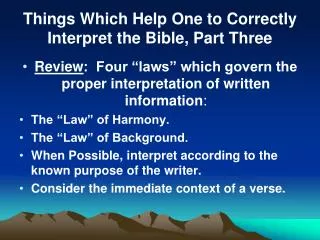
Things Which Help One to Correctly Interpret the Bible, Part Three • Review: Four “laws” which govern the proper interpretation of written information: • The “Law” of Harmony. • The “Law” of Background. • When Possible, interpret according to the known purpose of the writer. • Consider the immediate context of a verse.
Approach A Study of the Scriptures with the Proper Attitude! • Have an “Honest and a Good heart,” Luke 8:15. cf. John 3:1-2; 7:46-51. • Have a sincere love for the truth, 2 Thessalonians 2:10-12. • Remember that “God Cannot Lie,” Titus 1:2; Hebrews 6:18. • Remember that God is “not the Author of Confusion,” I Corinthians 14:33.
“Rule” One: • All words are to be understood in the literal sense, unless the evident meaning in the context forbids the literal. • Figurative language is the exception. • Illus. “Water” in John 3:5, 23. • The Golden rule of interpretation: “when the plain sense makes common sense, seek no other sense.”
“Rule” Two: • Caution must be exercised not to make literal what is figurative in nature, as defined by the context. • Note anthropomorphic terms used with reference to God, I Peter 3:12; Isa. 59:1-2 • To make God “once like we are” (Mormons) is to violate “the law of harmony” concerning what the Bible says about the nature of God! John 4:24; Lk. 24:39.
“Rule” Three: • Commands are generally to be understood in a Literal Sense. • A General rarely issues orders in figurative language! • Christ, our “captain” (Hebrews 2:10) rarely issues an order in figurative language.
“Rule” Four: • Words of Definite Action can have but one meaning. • Examples: Jump, sit, dip, sprinkle, etc. are words of definite action. • Bible Examples of words of definite action: • “Baptize,” Matthew 28:19. • “Sing,” I Corinthians 14:15.
“Rule” Five: • The Writer’s Own Explanation is the best definition that can be found. • Example: • “Immanuel” – “God with us,” Matthew 1:23. • Jesus was indeed “God with us!” John 10:30; John 8:58; 14:8-9.
“Rule” Six: • The Proper Definition of a word may be used in the place of a word. • Worded differently: the true meaning of a word will give the same sense as the word itself. • Examples: • The “called out” for “church,” I Cor. 1:1-2. • “Immersed” for “baptized,” Romans 6:3-4.
“Rule” Seven: • Illustrations (or Parables) may give the peculiar sense in which a word is to be understood. • Note “Love” and “neighbor,” as used in Luke 10:25-29. The meaning of both words illustrated in the Parable in Luke 10:30-37. • Note: “Beware of covetousness,” Lk. 12:16. The meaning of covetousness illustrated in the parable in Lk. 12:16-21.
Conclusion: • It is good to be aware of “the rules of interpretation” as it relates to communica- tion, whether verbal or written. But when it comes to the Bible, after we learn all the “rules of interpretation,” remember there is no substitute for hard work! 2 Peter 3:16. • It is good to “know the truth,” John 8:32, but knowledge apart from obedience is not sufficient! James 1:21.