Download
1 / 9
90 likes | 211 Views
This study explores the foundations of biblical translation and interpretation, emphasizing the importance of Scripture as God’s Word. Highlighting key figures such as John Wycliffe and William Tyndale, we delve into the historical context of various translations and the complexities involved in translating texts from one language and culture to another. Understanding these elements can enhance our confidence in the original Hebrew and Greek manuscripts while navigating the nuances of different versions, including the King James Version (KJV) and others.

E N D
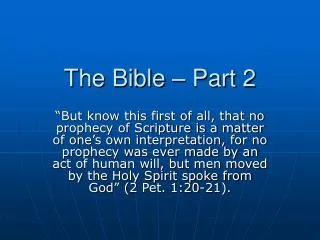
The Bible – Part 2 “But know this first of all, that no prophecy of Scripture is a matter of one’s own interpretation, for no prophecy was ever made by an act of human will, but men moved by the Holy Spirit spoke from God” (2 Pet. 1:20-21).
The Jewish – Christian Belief • God’s Word is God’s Word. • They revered it. If a scribe was copying a passage and thought there was a mistake, he wouldn’t change it “back”. God’s word can’t be willfully altered. • We can have confidence in our Hebrew and Greek text.
The “Received” Text • Textus Recepticus - An ancient text developed by comparing all the available manuscripts, the versions (translations) and the writings of the “church fathers”. • The Latin Vulgate became the basis for many of the English translations, such as the KJV.
Difficulties of Any Translation • To convert from one language to another. (“Full fathom five thy father lies…”) • To convert from one culture to another. (Passover becomes Easter – Acts 12:4, KJV). • To convert from one continent to another – many plants and animals in Israel are unknown to us. • Language changes. “Dead” languages vs. “living” ones.
Aelc thara the thas min word gehierth, and tha wyrcth, bith gelic thaem wisan were, se his hus ofer stan getimbrode. Tha com thaer regen and micel flod, and thaer bleowon windas, and ahruron on thaet hus, and hit na ne feoll: sothliche hit waes ofer stan getimbrod. • Matt. 7:24-25.
The Translators • John Wycliffe – From Latin to English, 1382. (revised by John Purvey). • William Tyndale – From Greek (based on Erasmus text) to English – but printed in Holland. Strangled to death and body burned for his efforts. • Much of his text is based on Wycliff.
Many Translations • Miles Coverdale – 1535 • Matthew’s Bible – 1537 by John Rogers • The “Great” Bible – 1539, first to be authorized to be read in churches. • The Bishop’s Bible – 1568. • The King James Bible – 1611. • All these made before the discovery of the 3 best manuscripts of NT
Does It Matter What Translation You Read? • Yes, and No. • A good Bible student can take any translation, even the New World Trans., and teach the truth. • Some are better than others. • KJV – weak in Heb. And Greek, strong in English – the Psalms “sing”. • ASV – strong in Heb. And Grk, weaker in English.