Download
1 / 5
60 likes | 210 Views
The periodic table is a systematic arrangement of elements that illustrates their properties and relationships. Originating from 10th-century chemists' desire to organize elements, Dmitri Mendeleev created the first functional table in 1867, grouping elements by similar properties and atomic mass, leaving spaces for undiscovered ones. The table categorizes elements into metals, non-metals, and metalloids and organizes them into periods (horizontal rows) and groups (vertical columns). Each group is characterized by unique reactivity and properties, such as alkali metals and noble gases.

E N D
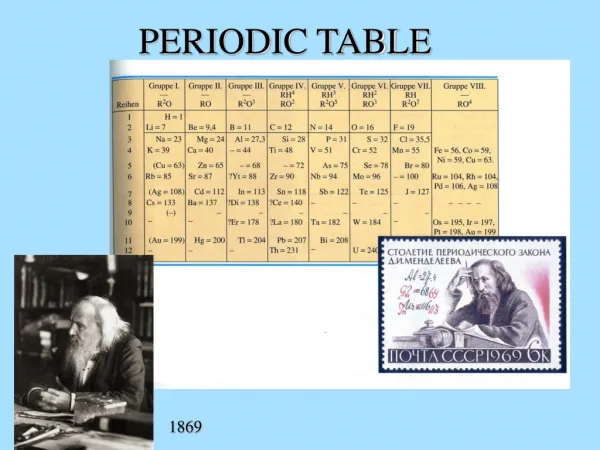
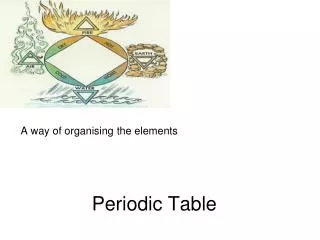
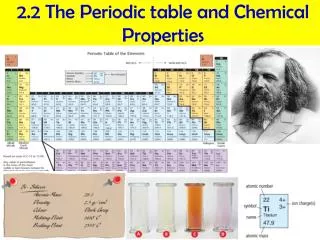
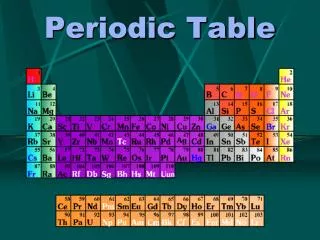
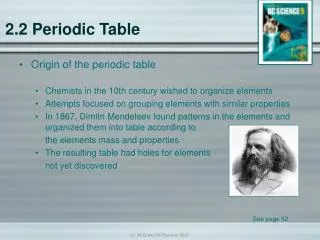
2.2 Periodic Table • Origin of the periodic table • Chemists in the 10th century wished to organize elements • Attempts focused on grouping elements with similar properties • In 1867, Dimitri Mendeleev found patterns in the elements and organized them into table according to the elements mass and properties • The resulting table had holes for elements not yet discovered See page 52 (c) McGraw Hill Ryerson 2007
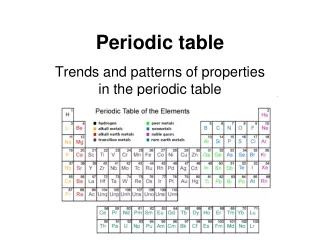
Periodic Table • The Periodic Table provides information on the physical and chemical properties of elements Atomic Mass - mass of average atom Atomic Number - number of protons Ion Charge - electric charge that forms when an atom gains or loses electrons See page 53 (c) McGraw Hill Ryerson 2007
Periodic Table See page 54 (c) McGraw Hill Ryerson 2007
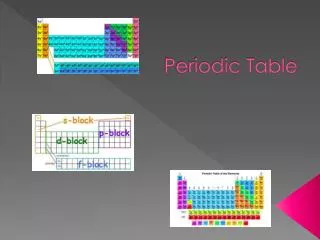
Metals, Non-metals, Metalloids • Period table has interesting patterns • Due to Mendeleev’s organization, interesting patterns are created, such as the groups: metals, non-metals and metalloids. See page 55 (c) McGraw Hill Ryerson 2007
Periods and Families • Each horizontal row in the periodic table is a period • Vertical columns form groups or chemical families • Alkali metals - highly reactive group 1 • Alkaline earth metals - group 2, burn in air if heated • Halogens - group 17, highly reactive non-metals • Noble gases - group 18, stable and unreactive non-metals See pages 56 - 57 (c) McGraw Hill Ryerson 2007