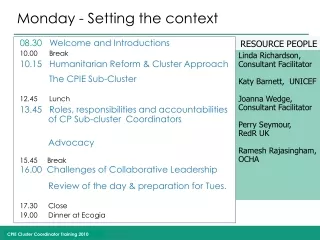
Setting the Context
This presentation by Irene Murphy at the Annual Conference for Vice Principals of Special Schools outlines a comprehensive framework aimed at improving Special Educational Needs (SEN) and inclusion strategies. Focusing on a whole-child approach, it emphasizes the importance of early identification, consistent assessment, and enhanced collaboration among stakeholders. It also highlights the growing need for support due to an increasing number of children with SEN. Key initiatives include capacity building, dissemination of good practices, and the establishment of multi-disciplinary groups to ensure optimal resources and accountability.

Setting the Context
E N D
Presentation Transcript
Every School A Good School:The Way Forward for SEN and Inclusion Presentation to Annual Conference for Vice Principals of Special SchoolsIrene Murphy20 May 2010
Setting the Context • Set within a strategic context and vision • The whole child/whole school approach • Capacity building • Multi-sectoral and multi-discipline interface • Extensive pre-consultation, followed by formal consultation • Wide-ranging, high level proposals
Setting the Context • Set within a strategic context and vision • The whole child/whole school approach • Capacity building • Multi-sectoral and multi-discipline interface • Extensive pre-consultation, followed by formal consultation • Wide-ranging, high level proposals
Policy Development Stage • Steering Group with 3 Advisory Groups • Informed by engagement with a cross-section of stakeholders • Equality Impact Assessment (EQIA)
Why change is needed • Inconsistencies and delays in assessment and provision • Increasing numbers of children with SEN, with statements and with significant needs • 4.1% of school population (13,567 children) with SEN statements (51% increase since 2000) • 19.2% of school population (63,100 children) on the SEN register • 69.3% of children with statements in mainstream classes or units attached to mainstream schools • Mounting pressures on parents, teachers, schools and ELBs • Schools seeking external supports for 35.6% of SEN children in mainstream schools
Background Facts 2008/09 • £202m to support SEN • £18m (additional to £202m) to support non-SEN barriers to learning 2007/08 • 5,665 newcomer children with English as an additional language (18% on SEN register) • 1002 looked after children (58% on SEN register) • 918 Forces children (16.7% on SEN register) • 822 Traveller children (50% on SEN register) • 1,500 post-primary pupils permanently out of school each year. • At least 25% of school population has some kind of barrier to learning, including SEN
Key considerations of the Review • Address early identification and intervention • Ensure consistency of assessment and provision • Effectively optimise resources • Develop opportunities for greater collaboration • Disseminate existing good practice • Ensure needs of all SEN pupils, including those in mainstream, are effectively met • Ensure all schools equipped to recognise and deal with diversity
Key themes of the proposals • Overarching, inclusive framework aimed at raising standards and outcomes for all • Inclusive model of a continuum of provision for a diversity of need - in different educational settings • Reduction or removal of barriers to learning faced by many children • Focus on early identification and intervention – the right support at the right time
Key themes of the proposals • Capacity building • Pre-school SEN assessment and provision • Consistency of provision • Enhanced role of schools • Dissemination of existing good practice and collaborative working • Improved multi-disciplinary and multi-agency working • Funding, outcomes and accountability
Additional Educational Needs Concept • Aims to ensure that each child and young person facing a barrier to learning has a fair and equal chance • ‘Additional educational needs’ is a concept • Provides an overarching, inclusive framework, which recognises the challenges and overlapping barriers to learning faced by many children • Recognises the challenges faced by teachers • Places the child firmly at the centre of the inclusive framework • Examines the combination of barriers to learning, rather than individual barriers in isolation - intends to complement and support SEN, but not redefine SEN
Early Identification and Intervention • Not just in pre-school or primary one • Children and young people facing barriers to learning should be identified as quickly as possible, regardless of age • Appropriate and timely educational support should be provided • All support programmes need to be monitored regularly
Multi-disciplinary Groups (MGs) • Provide advice to teachers and schools • Encourage the dissemination of existing good practice and collaborative working across schools and professionals • Consider the level and effectiveness of support provided by schools for children facing barriers to learning • Evaluate and determine the next steps for those children requiring multi-disciplinary support over and above that which the school can provide
Next Steps • Consultation period ran to 31 January 2010. • Development of capacity building programme • Summary of consultation responses prepared • Analysis of the responses undertaken • Policy proposals carefully reviewed in light of analysis • Consideration of proposals to be taken forward • Development of a pre-implementation plan – possible testing of practical out-workings of accepted proposals