Exploring Themes and Characters in Shakespeare's "Twelfth Night"
Dive into the intricate world of Shakespeare's "Twelfth Night", a comedy that beautifully explores themes of love, identity, and deception. Discover the complexity of characters such as Viola, who disguises herself as Cesario, and Orsino, who is caught in a love triangle that leads to unexpected revelations. Analyze the power dynamics between characters like Malvolio and Olivia, and the clever literary devices used throughout. This analysis reveals how love shapes actions, the impact of mistaken identities, and the folly of ambition, all while offering a glimpse into the humor woven through Shakespeare's text.

Exploring Themes and Characters in Shakespeare's "Twelfth Night"
E N D
Presentation Transcript
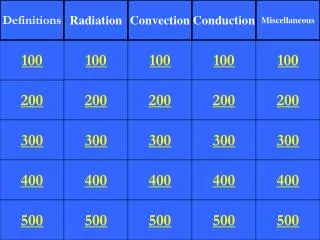
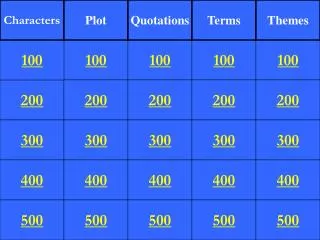
Characters Plot Quotations Terms Themes 100 100 100 100 100 200 200 200 200 200 300 300 300 300 300 400 400 400 400 400 500 500 500 500 500
Olivia swears that no one will see her face for 7 years for this reason.
What is, to get revenge on Malvolio for his unfair treatment of her?
The four things the letter tells Malvolio to do to show his love.
What is, wear yellow stockings, cross-gartered, smile all the time, and be rude to the other servants ?
The context and speaker of the following quotation: “Some are born great, some achieve greatness, and some have greatness thrust upon them.”
Who is Malvolio when he is reading the letter from “Olivia” suggesting that she “loves” him??
The literary devices used in the following quotation: “She never told her love,/But let concealment, like a worm i’ th’ bud,/Feed on her damask cheek.”
The context and the speaker of the following quotation: “If music be the food of love, play on.”
Who is Orsino when he is pining over the Lady Olivia at the beginning of the play?
The character who says, “O Time, thou must untangle this, not I./ It is too hard a knot for me to untie
Who is “Sir Topas” when he is talking to Malvolio in his dark cell implying that he is mad?
The literary device used to create humour using double entendre.
The theatrical convention where a character on stage speaks his thoughts to another character, or the audience, and other characters do not hear.
Theatrical convention where the character shares his thoughts with the audience alone on stage.
The term used to describe the audience knowing something the character does not.
The many references to Greek mythology in the play are examples of this device.
Theme revealed through Orsino’s and Malvolio’s love for Olivia.
What is, love makes people do foolish things, or love is blind?
Theme revealed by the dramatic irony created by love triangle (Orsino-Viola/Cesario-Olivia).
The theme revealed in the relationships between servants and their masters.