Download
1 / 4
40 likes | 160 Views
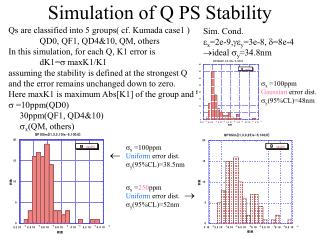
This study investigates dK2 errors during simulations involving multiple Q magnets, focusing on the effects of various parameters and corrections. We apply the equation dK2=2.sgn.K1.δ/r with r=10mm, and analyze the impact on dFD, demonstrating that a correction roll of 1mrad results in varied sy measurements at a 95% confidence level. After iterations, certain corrections prove ineffective, impacting the stability of sy significantly. We conclude that the tolerance of SK2 must be less than 1e-4 to ensure optimal performance in magnet modifications.

E N D
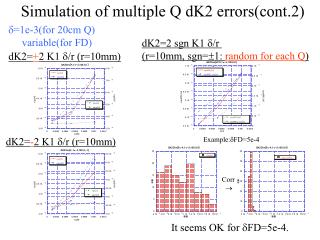
=1e-3(for 20cm Q) variable(for FD) Simulation of multiple Q dK2 errors(cont.2) dK2=2 sgn K1 /r (r=10mm, sgn=1: random for each Q) dK2=+2 K1 /r (r=10mm) dK2=-2 K1 /r (r=10mm) Example:dFD=5e-4 Corr It seems OK for dFD=5e-4.
dK2=2 sgn K1 /r Sin[q], dSK2=2 sgn K1 /r Cos[q] (r=10mm, sgn=1: random for each Q,0<q<2p:uniformly random) Simulation of multiple Q dK2 errors(cont.3) Correction: roll(1mrad step) of SX+K2(1% step) of SX dFD=1e-4 After cor., sy(95%CL)=44nm Iteration of correction x2 sy(95%CL)=47nm Iteration of cor. is not effective Cor. dFD=5e-4, d20cmQ=5e-4 After cor., sy(95%CL)=225nm SK2 of FD affects significantly to sy. Tolerance of SK2 should be much less than 1e-4. Cor.