Macromolecules
Macromolecules are the large, organic molecules essential for life, including proteins, carbohydrates, lipids, and nucleic acids. These molecules are made from smaller units known as monomers, which combine to form polymers. Each type performs critical functions: proteins build structures and speed up reactions, carbohydrates serve as energy sources, lipids store energy and insulate, and nucleic acids transmit genetic information. Understanding macromolecules reveals their diverse roles in biological systems and their importance in sustaining life.

Macromolecules
E N D
Presentation Transcript
Macromolecules Honors Biology
Macromolecules Are BIG molecules! • Building blocks of cells • Small monomers combine to form a polymer • All contain C, H, O
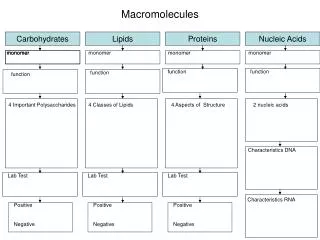
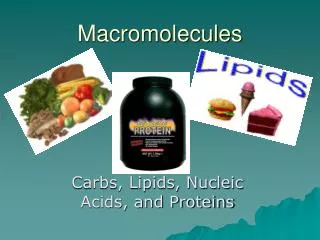
4 Types • Proteins • Carbohydrates • Lipids • Nucleic Acids • *All are organic – so all contain Carbon
Caloric Value • Energy in macromolecules is stored in the bonds that link smaller units together • Amount of energy stored varies with type of molecule formed • Proteins, carbs, lipids - different structures so different caloric values
Proteins • Have many different functions - as enzymes, transport of material, self-defense, structure of body
Proteins • Used mostly to build structures rather than for energy • Monomer = amino acids • Contains C, H, O, and N • Are millions of different kinds
Amino Acids – 20 different kinds • A.A.’s bond together by “peptide” bonds • Forms a polymer called a polypeptide • Different A.A.’s have different chemical properties
Proteins – Caloric Value • Amino acids - 12 are made in body; rest come from food • Same caloric value as carbs per gram • Proteins used for energy ONLY IF carbs or lipids not available
Protein Examples • Connective tissues • Hair and nails • Transport proteins • Hormone proteins • Muscles • Enzymes
Enzymes • A type of protein • Help control chemical reactions (speeds them up) • If you’re missing an enzyme, the chemical reaction it controls happens too slowly
Lipids • Phospholipids – make up structure of cell membrane • Other lipids – energy storage, signaling molecules, pigments
Lipids • Fats and oils – energy storage; some is needed in organisms • Saturated - solid at room temperature • Unsaturated - liquid
Lipids - Functions • Long term energy storage • Cushions internal organs • Insulation for body against temperature extremes • Important in hormones and vitamins
Lipid Base “Unit” • Does not have a “true” monomer • Triglyceride = 3 fatty acids + 1 glycerol • All lipids are “hydrophobic” (nonpolar)
Lipids • Have more C-H bonds than carbs so used for long term storage of energy • Used for energy when carbs are scarce; otherwise are stored
Lipids • Fats contain more energy (ATP) per gram than carbs or proteins - so have greater caloric value • Examples - Steroids, cholesterol, waxes, fats
Carbohydrates • Always made of C, H and O; forms long chains • Energy storage, cell structure, signaling • monomer = monosaccharide or “simple sugar” • Forms disaccharides and polysaccharides = polymers
Carbohydrates • When broken down by digestion, C-H-O can be used as raw materials for amino acids, fatty acids and other organic compounds. • Important source of fiber for animals. Most fiber is cellulose
Carbohydrates • Sugars and starches • Monosaccharides – glucose, fructose • Polysaccharides - starch, cellulose • Main source of energy for cells
Carbohydrates • Bonds break during digestion; energy is released and simple sugars absorbed through wall of intestine • Blood carries sugars to cells • Inside cells, sugars used as fuel during cell respiration (energy stored as ATP)
Carbohydrates • Caloric value depends on number of C-H bonds • If excess carbs in body, extra energy converted to fats and stored in body
Starch and Glycogen • Energy storing polysaccharides • Plants store energy as starch • Animals store energy as glycogen in the liver and muscles
Nucleic Acids • Monomer = nucleotide • Polymer = DNA and RNA • Store and transmit the genetic material
Nucleotides • A 5-carbon sugar + a phosphate + a nitrogenous base • Information in DNA used to make proteins