The Role of Macromolecules in Life: Carbohydrates, Lipids, Proteins, and Nucleic Acids
Macromolecules are vital components of life, formed from simpler units, significantly influencing biological processes. Carbohydrates, found in fruits and grains, consist of monosaccharides, providing immediate energy. Lipids serve as energy storage and include fats, oils, and steroids, while proteins, composed of amino acids, perform a range of functions from structural support to catalyzing reactions. Nucleic acids, like DNA and RNA, transmit genetic information essential for protein synthesis. Together, these macromolecules form the foundation of all living organisms.

The Role of Macromolecules in Life: Carbohydrates, Lipids, Proteins, and Nucleic Acids
E N D
Presentation Transcript
Macromolecules How do macromolecules influence life? (HINT: building blocks)
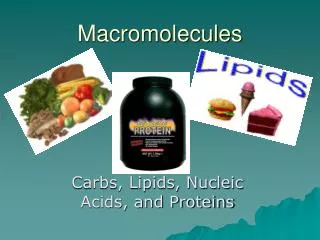
Carbohydrates • Found in fruits, vegetables, & grains • Made from monosaccharides (single sugars) which form polysaccharides • Examples: glucose, fructose, starch, sugars • We get energy from carbs!
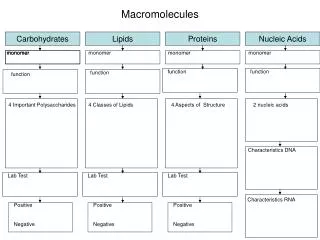
CARBOHYDRATES • “Ingredients” = C – H – O • Monomer (made of) : sugars • Ratio of 1 C : 2 H : 1 O • SUPPLY IMMEDIATE ENERGY • Examples: monosaccharide (aka simple sugar), disaccharide & polysaccharide (aka “starch or glycogen)
Lipids • They will not dissolve in water. • They are made of fatty acids & glycerol • They are fats,steroids,oils and waxes • Examples are margarine, shortening, meats, olive oil, peanut oil • Lipids are used for storing energy (why it pays to have some fat on you!)
LIPIDS • “Ingredients” = lots of C-H bonds with a small Oxygen group. • Monomer (made of): glycerol + fatty acids • ENERGY STORAGE MOLECULE • Examples: fats, oils, steroids, waxes
Proteins • Proteins are just chains of amino acids, like a beaded necklace, that sometimes fold into weird shapes • Their functions are VAST!!!!! • Enzymes (promote chemical reactions) • Provide structure (hair, bones, muscles) • Antibodies (fight infection) • Carry things (oxygen from lungs to rest of body)
PROTEINS • “Ingredients” = C-H-O + N • Monomers (made of): amino acids • BUILDING BLOCKS FOR TISSUES & ORGANIC CATALYSTS. • Example: enzymes
Nucleic Acids • Are made of nucleotides with 3 parts- • 5 carbon sugar+nitrogen base+phosphate group (no that’s not a band) • Commonly known as DNA and RNA • What they do: transmit genetic information (in other words, why you have great aunt Edna’s winning smile or uncle Harry’s ears)
NUCLEIC ACIDS • “Ingredients” = C-H-O-N + P • Monomer (made of): nucleotides (sugar, phosphate, Nitrogen base) • DNA and RNA (genetic code) that instruct cells to build proteins.