Chapter 8 Review
This chapter explores essential terms and concepts from the Industrial Revolution, focusing on processes like shearing, spinning wool into yarn, and the function of looms in cloth production. It discusses the role of vendors in providing goods and services, the impact of strikes led by workers, and the significance of mills in transforming raw materials. Additionally, it highlights the influence of immigrants on American business, the wealth of industrialists like Andrew Carnegie, and the formation of labor unions. Questions regarding the era's social changes and advancements are also included.

Chapter 8 Review
E N D
Presentation Transcript
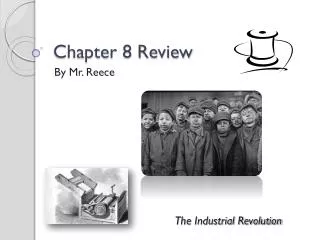
Chapter 8 Review By Mr. Reece The Industrial Revolution
Shear Terms to Know To cut wool off a sheep
Spin Terms to Know To make sheep’s wool into yarn
Loom Terms to Know A large frame used to make cloth
Vendors Terms to Know People or companies that provide a service or goods
Strike Terms to Know A period of time in which workers refuse to work until their demands are met
Mill Terms to Know A place of business where raw cotton, grain or lumber is made into useful products
Boom Terms to Know A sudden increase in production
Immigrants Terms to Know People coming to America from other countries
Andrew Carnegie Terms to Know Became one of the wealthiest men in the world
Union Terms to Know Group of workers who join together to help each other
Factory Terms to Know A place where industry takes place
Multiple Choice What was true of immigrants in 1840? A. They destroyed America’s business. B. They made America’s business successful C. The stole some of the American’s best jobs
Multiple Choice What was true of child labor during the American Industrial Revolution? A. There were rules about how long children could work B. Children usually earned only a $1.20 a day C. Some children were injured by the machinery
Multiple Choice During the American Industrial Revolution what was true of the nation? A. It became more “city” than “country” B. It became more “country” than “city” C. It developed equally in the city and the country
Multiple Choice During the American Industrial Revolution, what cause industries to spring up almost overnight? A. the invention of a new, improved spinning jenny B. the beginning of the Civil War C. a sudden loss of interest in buying land in the West
Multiple Choice After the steam engine was invented, A. The demand for cotton went down B. Lumbermen built bigger mills and hired more workers C. All the hand weavers began using engine-driven looms