Download
1 / 32
320 likes | 416 Views
This concise guide provides key insights into renal system tests like BUN, creatinine, and clearance, along with nursing implications, normal values, and indications for various renal diseases. It covers detailed information on blood urea nitrogen, creatinine clearance, and more.

E N D
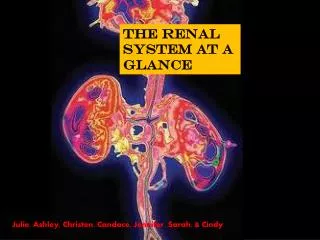
THE RENAL SYSTEM AT A GLANCE Julie, Ashley, Christen, Candace, Jennifer, Sarah, & Cindy
Objectives BUN • When is it used • Nursing implications • Normal values • Abnormal result Creatinine • When it is used • Nursing implications • Normal values • Abnormal result Creatinine Clearance • When it is used • Nursing implications normal values • Abnormal result Tests for BUN/Creatinine Renal Diseases/Illnesses Dialysis Methods
Blood Urea Nitrogen • Measures the amount of urea nitrogen in the blood • Urea is formed in the liver as the end product of protein metabolism and digestion • Protein is broken down into amino acids during ingestion, once in the liver, these amino acids are catabolized and free ammonia is formed. • Ammonia molecules are combined to form urea, which is then transported by the blood to the kidneys for excretion.
When is BUN Used? • Used to assess kidney function and liver function as well as glomerular filtration rate. • Levels reflect the balance between the production and excretion of urea. • It may also be used to determine if body fluids are urine or not.
Nursing Implications • Explain procedure to the patient • Provide teaching regarding what the test will be measuring. • Inform the patient that no fasting is required with this test. • Monitor puncture site for bleeding
Normal Values • Normal values for an adult under the age of 90 years old are 2.9-7.5 mmol/L • For patients over the age of 90, levels are 3.6-11.1 mmol/L
BUN • Cardiac Patients • Reduced Renal Perfusion • Intravascular Fluid Volume Deficit • Increase as GFR decreases • ARF • CRF • Dehydration • Altered Protein intake • Protein Catabolism
Creatinine • End product of creatine metabolism. • Creatineis an energy-requiring metabolite of the skeletal muscle. • Creatineis converted to creatinine during metabolism where it is filtered through the kidney’s and excreted. • Only a small amount of creatine is converted to creatinine, this level remains stable except when there is damage to skeletal muscle. • The measuring of creatinine is an indicator of renal function
Indications • Before administration of nephrotoxix medications, to assess renal function • Check glomerular function • Monitor effectiveness of renal treatment • Check accuracy of 24 hour urine collection • Assess level of nephrondamage
Nursing Implications • Inform patient the test if used to assess renal function • Obtain a detailed history, including medications • Discuss procedure with patient • Instruct patient as to proper procedure for urine collection. • Discuss with patient the process of a 24 hour urine collection.
Factors effecting levels Creatinine • Extremes of age and body size • Severe malnutrition or obesity • Disease of skeletal muscle • Paraplegia or quadriplegia • Vegetarian diet • Rapidly changing kidney function • Pregnancy
Creatinine • Increased In: • Nephritis • Chronic Renal Disease • Decreased In: • Muscular Atrophy • Anemia • Advanced Degeneration of the Kidneys
Creatinine Clearance • Diagnostic test of renal function • Compares the amount of creatinine in a blood sample and urine sample to determine rate the kidneys are clearing creatinine from the blood • Measure of glomerular filtration rate
Indications • Determine extent of nephron damage in known renal disease • Before administering nephrotoxic drugs • Accuracy of 24-hr urine collection • Assess glomerular function • Effectiveness renal disease treatment
Normal Values • Adult male 85-125mL/min/1.73 m • Adult female 75-115mL/min/1.73 m • Each decade after 40 y decrease of 6-7 mL/min/m (conventional units x 0.0167)
abnormal result • Degree of impairment: • Borderline: 62.5-80 mL/min/m • Slight: 52-62.5 mL/min/m • Mild: 42-52 mL/min/m • Moderate: 28-42 mL/min/m • Marked: Less than 28 mL/min/m 2
Nursing Implications • Inform patient of test • Obtain pt. genitourinary history & results of related tests/procedures • Obtain list of medications pt. taking • Review procedure • Inform pt. urine timeframe of urine collection & to void all urine in collection device • Sensitivity to social & cultural issues
Creatinine Clearance • Decreased In: • Kidney Diseases • Acute Renal Failure • Chronic Renal Failure • Increased In: • Diabetes • Renal Artery Obstruction • Renal Vein Thrombosis • Glomularulonephritis • Nephritis
Tests For... Creatinine BUN Blood/serum: Serum (about 1mL) collected in a red or tiger- top tube. Or Plasma collected in green- top (heparin) tube is also acceptable • Blood/serum: • Serum (about 1mL) collected in a red or tiger- top tube. Or • Plasma collected in green- top (heparin) tube is also acceptable • Urine: • Urine (5mL) collected from an unpreserved random or timed specimen – needs to be collected in a clean plastic collection container
How to Test... Blood Urine
Random Specimen Clean Catch Timed Obtain a 3L urine specimen container, toilet-mounted collection device and a plastic bag for transporting the specimen container • Female client procedure • Male client procedure
Dialysis • When your kidney’s cannot adequately remove waste from your body dialysis may be implemented • Pts can survive on dialysis for years • The only way to stop dialysis (and still survive) is to have a kidney transplant
Why Have Dialysis? Because it treats: • Renal Failure • Edema • Hepatic coma • Hyperkalemia • Hypercalcemia • Hypertension • Uremia • Fluid overload • Pulmonary edema • Acidosis • Pericarditis • Severe confusion
There are 2 Types of Dialysis Hemodialysis Periotoneal Dialysis
Hemodialysis • Hemodialysisworks to • remove toxins (N) & excess water from the blood stream • maintain and restore the electrolyte balance & acid-base buffer system (done in the dialyzer) • have ‘clean’ or filtered blood re enter the body as it would when leaving the kidney
Dialyzer The blood filtering device • Filtration through: • Diffusion – how the toxins are removed • Osmosis – takes away extra water • Ultrafiltration – takes away extra water
Complications • Artherioscleroticcardiovascular disease • Hypertriglyceridema • Amemia • Fatigue • Gastric ulcer • Fluid overload • Exsangulation • Hypotension • Muscle cramping • Air emboli • Dysrythmia • Chest pain • Cerebral fluid shifts
Peritoneal Dialysis • Peritoneal dialysis is implemented to... • Remove the toxic fluids • Remove metabolic wastes • Re-establish normal fluid and electrolyte balance. Who needs treatment? Who should not receive this treatment? How to patients receive this treatment? How does this effect a patient receiving this treatment?
Complications • Peritonitis • Leakage • Bleeding • Hypertriglyceridemia • Abdominal hernias • Clot Formation • Constipation
References • Day, R.A., Paul, P., Williams, B., Smeltzer, S.C. & Bare, B. (2006). Textbook of medical-surgical nursing. Philadelphia, PA: Lippincott Williams and Wilkins. • McCance, K.L. & Huether, S.E (2006). Pathophysiology: The biological basis for disease in adults and children. St. Louis, MO: Elsevier Mosby. • Myers, T. (Ed.). (2006). Mosby’s dictionary of medicine, nursing and health professions (7th ed.). St. Louis, MO: Mosby Elsevier. • Pagana, K.D. & Pagana, T.J. (2010). Mosby’s manual of diagnostic and laboratory tests (4th ed.) St. Louis, MO: Mosby’s Elsevier Inc. • Van Leeuwen, A.M, Kranpitz, T.R and Smith, L. (2006). Davis’s comprehensive handbook of laboratory and diagnostic tests withnursing implications (2nd ed.). Philadelphia, PA: F.A Davis Company.