Download
1 / 6
60 likes | 171 Views
Explore the intricate network of blood and capillaries, the vital components of the human circulatory system. Learn about the diverse cellular elements, plasma composition, and the functions of platelets. Understand how capillaries facilitate the transport of substances between blood and interstitial fluid through various mechanisms.

E N D
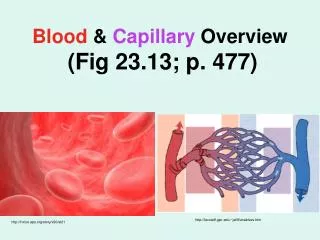
Blood & Capillary Overview(Fig 23.13; p. 477) http://facstaff.gpc.edu/~jaliff/anablves.htm http://focus.aps.org/story/v20/st21
Blood • Human Circ. System has 4-6 L. • Cellular Elements represent 45% of total blood volume. • RBCs & WBCs • Plasma (Straw colored liquid) • Platelets (part of bone marrow cytoplasm)
Plasma • Makes up over 1/2 of blood volume. • 90% is H2O • 10% is inorganic salts (ions, proteins, etc) • Ions = osmotic balance / pH balance • Proteins = • Blood clotting (fibrinogen) • Immunity (immunoglobulins)
Capillaries • Thin enough for Transport of Substances between Blood and Interstitial Fluid. • Composed of epithelial cells.
Transport of Substances(Fig. 23.12B; p. 476) • O2 & CO2 = Diffusion • Lgr. Molecules = Vesicles/Endocytosis /Exocytosis • H2O & Solutes = “Leaky clefts” • Proteins = Too Big to pass through
Forces Transport of Substances • Blood Pressure - active force pushing fluid outward. • Osmotic Pressure - active force pulling fluid inward (* [solute] in blood ).