Scabies
160 likes | 259 Views
Scabies is a skin problem caused by a mite laying eggs under the skin, leading to extreme itching, rashes, and bumps. Learn about symptoms, how it spreads, prevention tips, treatments, and where scabies is commonly found. Get essential information on this skin condition to protect yourself and others. Contact Heartland Health Outreach for Refugee Health Programs for assistance in dealing with scabies. This resource includes valuable insights from March 2009 for effective management of scabies infections.


Scabies
E N D
Presentation Transcript
Scabies Refugee Health Programs March 2009
Scabies Scabies is a skin problem caused by a bug called a mite. A female mite lays eggs under the skin of a human and stays inside until she dies. We cannot see scabies because they are very small.
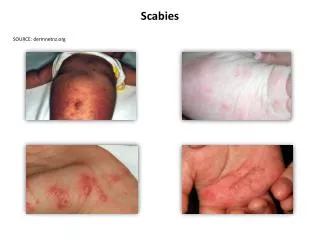
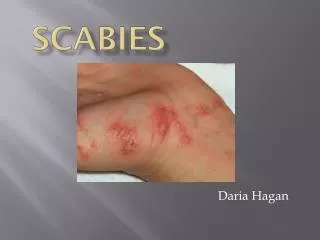
Symptoms • Scabies only affects the skin, outside the body. • Scabies causes extreme itching, which is usually worse at night. • Rashes, blisters, or bumps may appear. • Rashes and itching may last for 2-3 weeks, even after being treated.
Where Scabies Is Mainly Found • In between the fingers • Around the head and neck • Wrist, nipple, elbow, waist, armpit, buttocks, penis, shoulder • Hands and feet (especially in children)
If You Think You Have Scabies • If you think you might have scabies, check with a doctor or nurse. • Try not to scratch: scratching scabies can lead to skin sores that can become infected. • Don’t share personal items with others.
How Does Scabies Spread? Scabies is passed from one person to another: • Through skin–to-skin contact, • By touching an infected person’s items (such as clothing), • Through sexual contact. • Remember! Until you are cured, you can continue to pass scabies on to others.
Prevention • If you know somebody who has scabies, try not to touch their skin. • Do not share clothes with an infected person. • Wash bedding in hot water and dry at high temperatures (130 degrees Fahrenheit) for at least 20 minutes. • If you are not able to wash something, sealing it in a plastic bag will kill the bugs.
Treatments • The only treatment for scabies is a medicine that must be prescribed by a doctor. • Itching a scabies rash can make the infection worse. • People living in the same house, or who has had skin-to-skin contact with an infected person should also take medicine. • Everybody taking the medicine should use it at the same time so the bugs don’t come back.
Scabies Refugee Health Programs Heartland Health Outreach 1331 W Albion Chicago, IL 60626 www.heartlandalliance.org/refugeehealth 773.751.4166 ph This multi-media document was made possible with funding from the Office of Refugee Resettlement, Department of Health and Human Services provided to the Illinois Department of Public Health. March 2009