
Exploring the Periodic Table: Elements, Characteristics, and Properties
E N D
Presentation Transcript
History • Dimitri Mendeleev is considered the father of the Periodic Table • Based on atomic mass, though he knew that was wrong. • Was able to predict several elements and left space on the table. • First one to organize all data for elements efficiently. • The modern Periodic Table is based on increasing atomic number • Modern Periodic Theory states that periodicity is based on number of valence electrons.
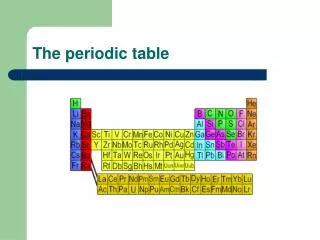
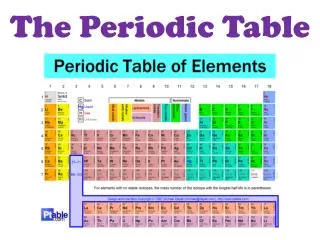
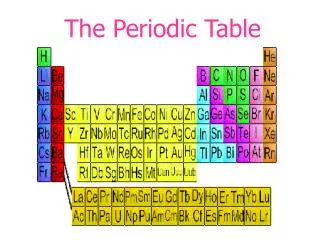
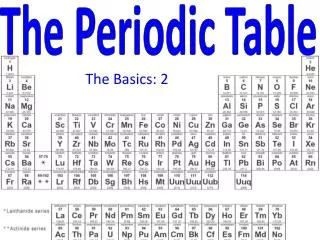
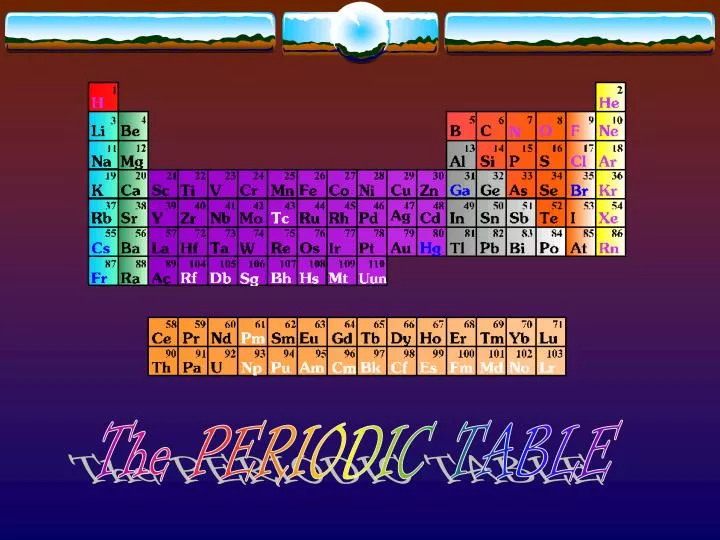
Periodic Groups Periods Table (Families) Rows Columns Numbered: Numbered: 1 through 18 1through 7
Important Definitions • Valence electrons: electrons in outermost energy level • Electronegativity: rating 0-4 of desire an atom has to gain an electron • Ionization energy: amount of energy needed to remove one valence electron. Referred to as first and second (energy needed to remove next outermost electron)
Every Group Has a Name 1 2 3 - 12 17 18 Transi t ion Earth Alka l i Halogens Alkal ine Nobl e Me t a l s Ga s s e s Me t a l s Meta ls
There are THREE Types of Elements: Metals Non Metals • Solids • Density greater than water • Malleable • Ductile • Luster • Conductors • Low ionization energy • and electronegativity values • Form positive ions • Gasses • Brittle (when solid) • Dull surface • Poor Conductors • High ionization energy and electronegativity values • Form negative ions Metalloids B, Si, Ge, As, Sb, Te, Po, At *Display BOTHCharacteristics
EXCEPTIONS: Bromine and Mercury are LIQUIDS at Room Temperature
*Non Metals* Mostly Gasses *Metals* *Metalloids*
EXCEPTION: *Hydrogen is NOT a Metal* *Al is NOT a Metalloid*
Using the information we just learned, Describe the following pictures: