Chemical Reactions, Bonding, and Trends in Group Hydrides: A Collaborative Research Task
In this collaborative learning task, students will explore key chemical reactions, including the displacement reaction of zinc in copper sulfate and the process of photosynthesis, where glucose and oxygen are produced. The focus will then transition to intermolecular bonding types such as hydrogen bonding and London dispersion forces. Groups will research these concepts, share findings, and analyze trends in boiling points among Group 6 and Group 7 hydrides, culminating in a graph presentation that illustrates their research and insights.

Chemical Reactions, Bonding, and Trends in Group Hydrides: A Collaborative Research Task
E N D
Presentation Transcript
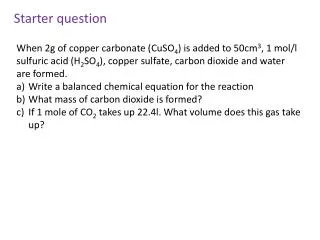
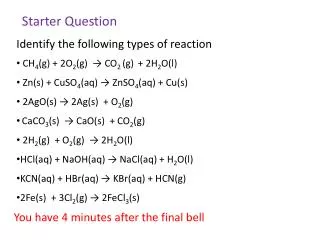
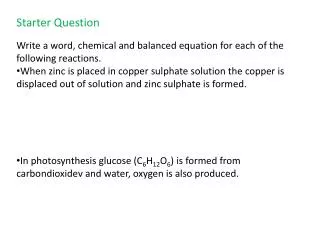
Starter Question • Write a word, chemical and balanced equation for each of the following reactions. • When zinc is placed in copper sulphate solution the copper is displaced out of solution and zinc sulphate is formed. • In photosynthesis glucose (C6H12O6) is formed from carbondioxidev and water, oxygen is also produced.
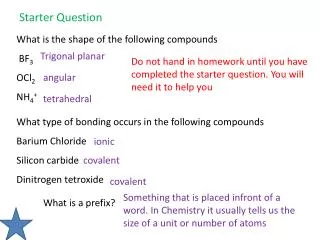
Inter- Molecular Bonding This is bonding that occurs between molecules Hydrogen bonding London Forces Polar- polar attractions
Today’s Task In your groups you must research: Polar- polar attractions Hydrogen bonding London dispersion forces You have 30 minutes to complete this task
You now have 15 minutes to share the information you researched with the rest of your group. You will then need to hand in your research as a group
Now plot a graph of the group 6 hydrides and explain the trend that you see. Then add the boiling points of the group 7 hydrides to your graph and explain the trend