Download
1 / 9
90 likes | 239 Views
This guide explores the fundamentals of electric current and voltage in circuits. It discusses how to calculate charge flow using the relationship between current, time, and charge, demonstrating with an example where 0.15A flows for one minute. Learn the proper setup for series circuits with two bulbs, and how to measure current with ammeters and voltage with voltmeters. We will cover concepts such as the uniformity of current in series circuits, the relationship between voltage and the push on electrons, and the importance of proper circuit setup for accurate measurements.

E N D
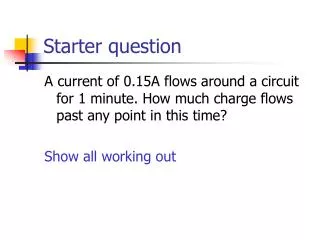
Starter question A current of 0.15A flows around a circuit for 1 minute. How much charge flows past any point in this time? Show all working out
The answer Charge = current x time (C) (A) (s) Charge = 0.15 x 60 Charge = 9C Correct it if it’s wrong
Objectives • Explain what is meant by electric current and voltage • Correctly set up 2 bulbs in series • Correctly set up a voltmeter and ammeter and take measurements
Current In an electric c____, currentis the flow of e_______. The bigger the current, the m___ electrons are flowing around the circuit. The w___ carry the electrons from one terminal around the circuit to the other t______. ircuit ore lectrons ires erminal lamps
Measuring current I In a series circuit the current is the same wherever you measure it. When measuring current ammeters are always placed in series. Set up the circuit shown below…… …and then record the current using an ammeter in the places shown below. The current is the same for each ammeter. What do you notice about the readings? A A A
Voltage oltage The v_____ is a measure of how big a push the e_______ are given as they leave the cell or b_____. The bigger the voltage, the bigger the p___. The cell, battery or p____ s_____ produces the voltage. lectrons attery ush ower upply lamps
Measuring voltage I For a series circuit, the sum of the voltages for each component is equal to the voltage across the cell or battery. V1 = V2 + V3 Set up the apparatus as shown…… …then record the voltages at the locations shown. What do you notice about the readings? V1 1.5 NB Voltmeters are connected in parallel 0.75 0.75 V2 V3
I hate to be negative! But don’t forget the detention tomorrow