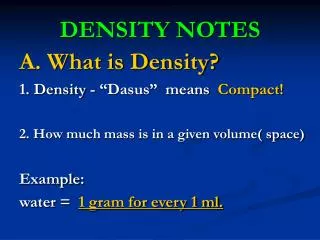
Understanding Density: Why Objects Float or Sink in Water
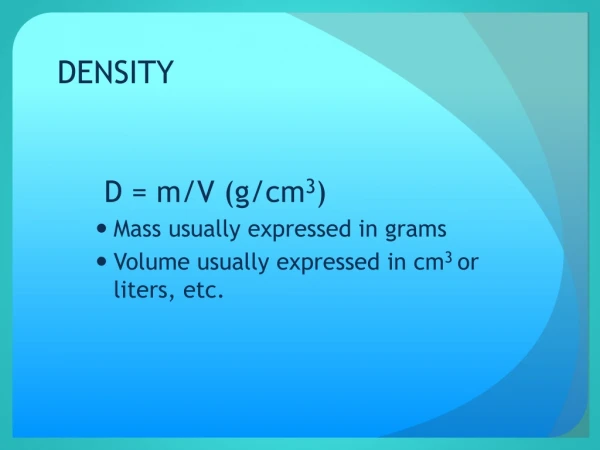
Density is a fundamental property defined as mass per unit volume. For instance, gold has a high density of 19.3 g/cm³, making it feel heavy for its size, while plastic has a low density of 1 g/cm³, resulting in a lighter feel. An object's ability to float is determined by its density relative to water (1 g/cm³); anything less will float. This principle explains why large steel ships can float despite steel's density of 7.8 g/cm³. Their design allows them to have an overall density less than that of water, preventing sinking when properly sealed.


Understanding Density: Why Objects Float or Sink in Water
E N D
Presentation Transcript
Gold is very dense - it feels very heavy for its size. D =19.3g/cm3
Plastic is not very dense - it feels light for its size. P = 1g/cm3
Each substance has its own density. A larger amount will still have the same density because it will be an equivalent fraction.
Solving for density: D = Mass / Volume Examples: • water: 100g 100ml = 1g/ml • nylon: 10g 8.7cm3 = • glass: 4g 1cm3 =
I can make something have less density by increasing the volume until it is more than the mass.
Floating in the water… • Anything with a density less than one will float in water. If there are numbers to the left of the decimal it will sink! • In other words… • Fill your lungs to float better!
So why do ships float ? The density of steel is 7.8 g/cm3 The density of waters 1 g/cm3 Think of a steel ship as a can that is empty and watertight. The majority of its space is taken up by nothing more than air which has a specific gravity of about 0.00129. So if I make a ship that is like a can, empty inside and watertight it floats. Its volume sufficient that it causes its specific gravity (overall density) to remain below 1.0 even after adding the weight of its contents. The steel ship will remain afloat as long as its density remains below that of water. The problem is that if water is allowed to enter the ship it would sink. Ships made of steel have to be sealed so water can not get in and increase its density. Steel can float only because of the way it is shaped, the space it takes up, and the seal that keeps it watertight.