Density Notes- Part 1 Chemistry 1
130 likes | 295 Views
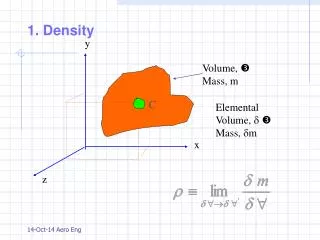
Density Notes- Part 1 Chemistry 1. Density. The compactness and size of the molecules or particles of a substance the more compact or squished together the molecules are and the more mass the particles have, the larger the density The relationship between an object’s MASS and VOLUME


Density Notes- Part 1 Chemistry 1
E N D
Presentation Transcript
Density • The compactness and size of the molecules or particles of a substance • the more compact or squished together the molecules are and the more mass the particles have, the larger the density • The relationship between an object’s MASS and VOLUME • Density is a characteristic property of substances and can be used to help identify substances.
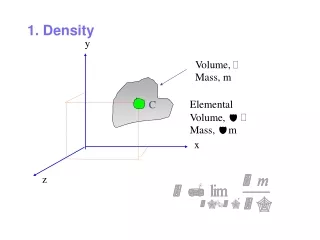
MASS is the amount of matter an object contains • Mass does not change unless you add or remove matter • VOLUME is the amount of space an object occupies • Density = Mass Volume
Finding Mass and Volume • Mass is always determined using a balance. • Triple beam or electronic • Remember you always must take into account the mass of the container one of two ways: • Tare the balance (zero out the container’s mass) • Or measuring the mass of the container and then subtracting it out later from the total mass of the container + substance
Volume can be found in different ways, depending on the substance or object.
Liquid volumes are read in volumetric lab equipment, like a graduated cylinder or pipet.
The dimensions of regularly shaped objects may be measured and then the volume found by using a formula such as V=l x w x h.
The volume of irregularly shaped objects may be found by water displacement • measure a given amount of water in a graduated cylinder • add the object and read the volume of the water + object • then find the volume of the object by subtraction. Amount of H2O with object = ______About of H2O without object = ______Difference = Volume = ______
Units • Mass units are usually grams (g) • Volume units are usually • Milliliters (mL) or cubic centimeters (cm3)for liquids or solids • 1mL = 1cm3 • L for gases • Density units will always be a Mass unit like g/mL or g/cm3 or g/L volume unit
Using the density formula • D=m/v can be used to solve for density if the mass and volume is known • What if the density is known, and you need to find the mass or volume? • Just rearrange the formula to solve for the unknown m=Dv or v=m/D
examples A 10.0mL sample of a sugar solution has a mass of 5.0g. What is the density of the sugar solution?
A piece of metal has a mass of 114g and a volume of 10.0cm3. What is the density of the metal?
A substance’s density is known to be 5.6g/mL. You have a 25.0mL sample of the substance. What is the mass of the sample?