Direct Object Pronouns
50 likes | 202 Views
This guide explains direct object pronouns in Spanish, focusing on their function and usage in sentences. Direct object pronouns replace nouns that receive the action of the verb, answering the questions "whom?" or "what?" Examples such as "Tengo el pasaporte" and its pronoun form "Lo tengo" illustrate their application. This resource covers both singular and plural pronouns, correct placement before conjugated verbs, and rules for use with infinitives. Enhance your Spanish grammar knowledge with clear examples and practical tips.


Direct Object Pronouns
E N D
Presentation Transcript
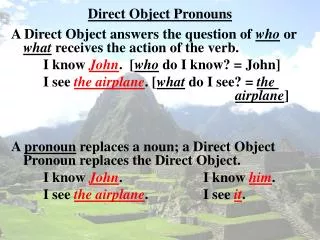
Direct Object Pronouns Direct objects receive the action of the verb in a sentence. They answer the question whom? or what? About the verb. Direct object pronouns take the place of direct object nouns.
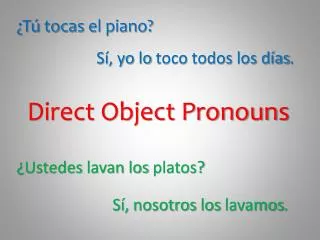
I have the passport. I have it. (noun) (pronoun) • Tengo el pasaporte. Lo tengo. (noun) (pronoun)
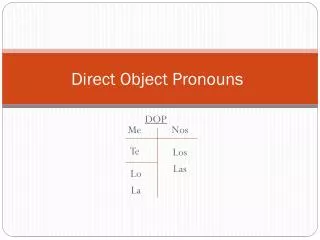
Singular me me te you (fam) lo (masc)you (form), him, it la (fem) you (form), her, it Plural nos us os you (fam) los(masc)you, them las(fem) you, them Direct object pronouns can be used to replace direct object nouns.
Direct object pronouns are placed directly before conjugated verbs. • Veo a la profesora. • I see the teacher. • Laveo. • I see her. • Héctor tiene el itinerario. • Héctor has the itinerary. • Héctor lotiene. • Héctor has it.
When an infinitive follows the conjugated verb, the direct object pronoun can be placed before the conjugated verb or attached to the infinitive. • No voy a hacer la maleta hoy. • I’m not going to pack the suitcase today. • No lavoy a hacer hoy. Or • No voy a hacerla hoy. • I’m not going to pack it today.