Download
1 / 20
210 likes | 237 Views
Learn how to define and effectively use direct object pronouns to enhance your Spanish language skills, avoiding redundancy. Understand their functions and agreements with nouns for clear communication.

E N D
Direct Object Pronouns Avancemos 2 Unidad 1 lección 1
Objective/EQ Objective: I can define what a direct object pronoun is and use them effectively to avoid redundancy. Essential questions: What is a direct object? What is a DOP? What is its function?
A direct object answers who or what after a verb. Comprendola pregunta. I understand what? . .. the question Direct Object Pronouns
Direct Object Pronouns • To avoid repeating a direct object, we often replace it with “it” or “them”. • Do you understand the question? • Yes, I understand it. • Do you understand the questions? • Yes, I understand them.
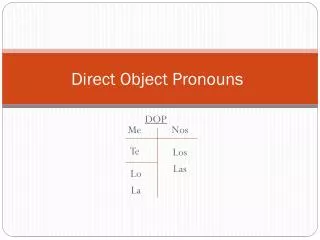
Direct Object Pronouns • Spanish works the same way. • The direct object pronouns are:
Direct Object Pronouns • Direct object pronouns can refer to people or things. • They agree in gender and number with the nouns they replace.
Direct Object Pronouns • Lo replaces a masculine singular noun. • La replaces a feminine singular noun.
Direct Object Pronouns • Los replaces a masculine plural noun • Las replaces a feminine plural noun
For example • If Tomás were to be referred to as him, lo would be the pronoun we would use. • Tomás = masculine singular • Masculine singular d.o. pronoun = lo
For example • If shoes were to be referred to as them, we would chooselos. • Zapatos= Masculine plural • Los= Masculine plural pronoun
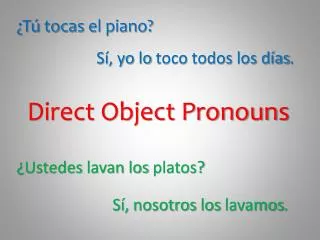
Direct Object Pronouns • A direct object pronoun is placed just before the conjugated verb. • ¿Lees el periódico? • Síloleo.
****If there is an infinitive verb, the pronoun is attached to the infinitive ending. • ¿Puedes lavar los platos? • Sí, puedo lavarlos.
When the pronoun replaces both a masculine and feminine direct object noun, los is used. • ¿Comprasel vestido y las dos faldas? • Sí, loscompro.
Practice • Translate: • Do you want my notebook? • Yes I want it. Thank you
Practice • Answer: • ¿Quieresmi cuaderno? • Sí, loquiero. Gracias.
Practice • Translate: • I have to call Gloria. • Do you have to call her?
Practice • Answer: • Tengoquellamar a Gloria. • ¿Tienesquellamarla?
Practice • Translate: • I pack the suitcase • I don’t pack it.
Practice • Answer: • Yo hago la maleta. • Yo no la hago.