Download
1 / 7
70 likes | 202 Views
This guide explains direct object pronouns (DOP) in Spanish: me, te, nos, lo, la, los, and las. It highlights that direct object pronouns replace direct object nouns and can refer to both objects and people. Pronouns like me, te, nos, and os specifically refer to people. Key points include the positioning of DOPs before conjugated verbs and how they can be attached to infinitives. Examples such as "¿Me ayudas, por favor?" illustrate their usage. Master these pronouns for fluent Spanish communication!

E N D
Direct Object Pronouns p. 41 Avancemos 2
DOP: Me, Te, Nos • You know that direct object pronouns replace direct object nouns. • The Direct object pronouns lo, la, los, and las can refer to both objects and people.
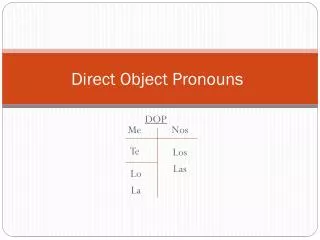
DOP: Me, Te, Nos • The pronouns me, te, nos, and os refer only to people. • Here are all the direct object pronouns:
Singular me me te you (inf.) lo him, it you (f.) la her, it you (f.) DOP: Me, Te, Nos Plural nos us os you (inf.) los them, you las them, you
DOP: Me, Te, Nos • Remember that in Spanish the subject and the verb ending tell who does the action and the direct object pronoun indicates who receives the action. • ¿Me ayudas, por favor? • Can you help me please?
DOP: Me, Te, Nos • Direct object pronouns usually come right before the conjugated verb. • When an infinitive follows a conjugated verb, the direct object pronoun can be placed before the first verb or attached to the infinitive.
DOP: Me, Te, Nos • ¡No te entiendo! • (Before the conjugated verb.) • Quieren llevarnos al centro. • (Attached to the infinitive.)