Understanding the Geologic Time Scale and Its Importance in Science
Explore how scientists track time through the geologic time scale, crucial for understanding Earth's history. This lesson covers the significance of timekeeping in scientific research, the study guide on sexual reproduction in plants, and the basics of classification in biology, including the six kingdoms: Plantae, Protista, Animalia, Fungi, Bacteria, and Archaea. Through interactive discussions and homework assignments, students will grasp key concepts such as the Law of Superposition and the evolution of species over time.

Understanding the Geologic Time Scale and Its Importance in Science
E N D
Presentation Transcript
Geologic time scale day 2 5-21-14
5-21-14 Bell Work: • How do scientists keep track of time? • How do you keep track of time?
Daily Review: • Why do you think it is important for scientists to keep track of time?
Study Guide (1-16) 1. Sexual reproduction. 2. Nucleus. 3. Pea plants grow quickly. They produce seeds quickly. Many observable characteristics. 4. Genes.
5. aa 6. ½ from each 7. Gregor Mendel
R r R r 8.
9. RR, Rr 10. nutrients 11. the sun 12. Habitat
13. grasses and weeds 14. desert 15. producers 16. tertiary
There are 6 kingdoms: • Plantae-have chlorophyll, cell walls, multicellular • Protista-parasitic, can be unicelluar or multicellular. • Animalia- multicellular, organs, tissues, can be vertebrates or invertebrates • Fungi-multicellular, have cell walls • Bacteria-No Nucleus • Archaea-single celled, microscopic
5-21-14 Objective: • I will finish my Geological Time Scale. • HW: Study Guide 17-33
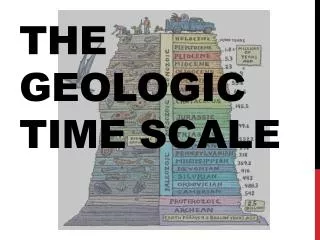
Vocabulary: Law of Superposition-states that the top layer of ground is the youngest layer and the layers of ground beneath that are older. Stratigraphic Column-a diagram showing the series of layers of rock.
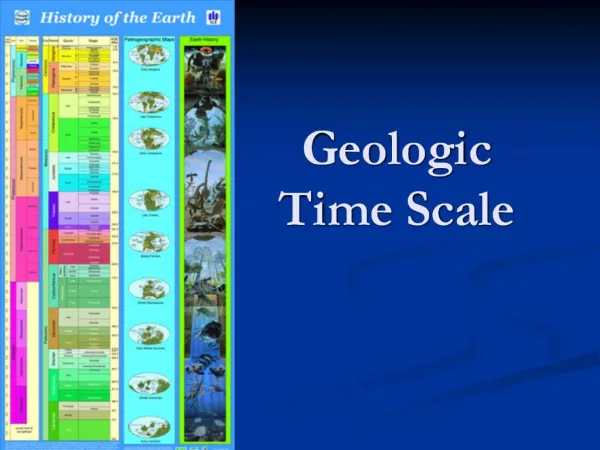
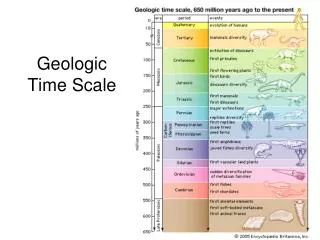
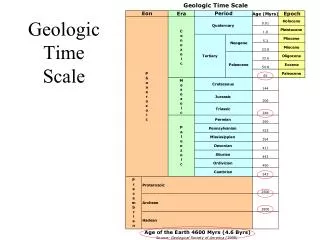
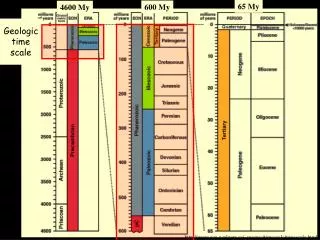
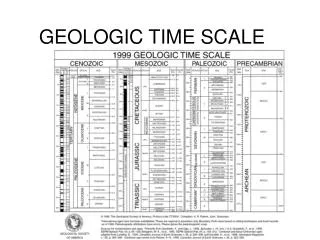
Page F-24 • Early Precambrian-Bacteria • Late Precambrian-Elrathikingi • Early Paleozoic-Mucrospiriferthedfordensis, Elrathikingi • Late Paleozoic-Tabulopyllum, Ammonite, Goniobasistenera • Mesozic-Alethopterisserii, knightia- • Cenozoic-Admetopissbfsiformis, early man, wooly mammoth
Horse Evolution • Read pages 102-103. • Answer the stopping to think questions. • Answer the questions 1-3.
Closure: • How do scientists know which fossils are the oldest?
Long Term Memory Review • What does a food chain show.