Geologic Time Scale
Geologic Time Scale. Chapter 9, Section 3. Measuring Time. The Earth has existed for 4.6 billion years The geologic time scale divides all those years into sections Each section shows a specific change in life or in the Earth’s surface. Giving Time a Name.

Geologic Time Scale
E N D
Presentation Transcript
Geologic Time Scale Chapter 9, Section 3
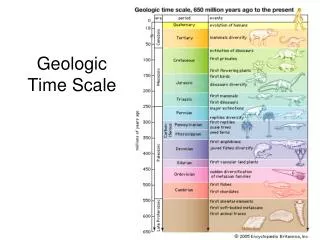
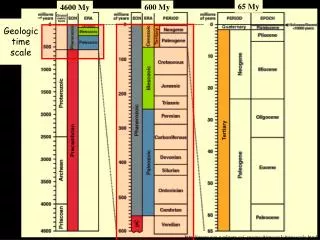
Measuring Time • The Earth has existed for 4.6 billion years • The geologic time scale divides all those years into sections • Each section shows a specific change in life or in the Earth’s surface
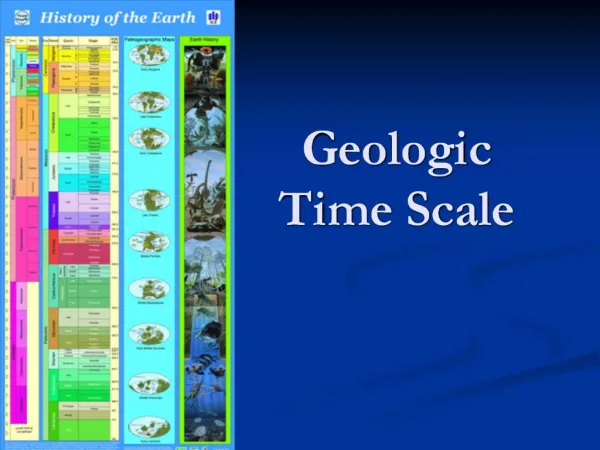
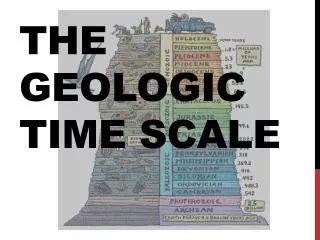
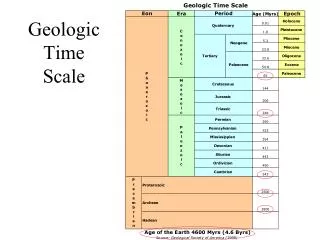
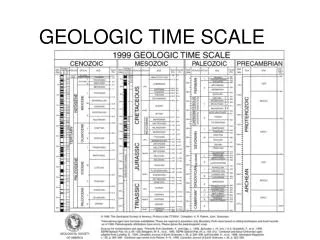
Giving Time a Name • The largest sections are called “eons” • “Eons” are divided into “eras” (the 2nd largest section) • “Eras” are divided into “periods” • Then “periods” are divided into “epochs” • Usually the oldest sections are shown on the bottom and the most recent sections are shown on the top
How is Time Divided? • Major changes in Earth’s history mark the boundaries between the sections • Most sections have been divided because a major organism developed or went extinct.
Extinction • Extinction = the death of every member of a species • It can happen because the environment changed, and some organisms could not survive in the new environment.
Mass Extinction • Mass extinction = the extinction of many species at the same time • Can you think of an example of a mass extinction? • It can be caused by gradual changes in climate or ocean currents (Uniformitarianism) • Or by catastrophic events, like an asteroid hitting the earth and blocking out the sun (Catastrophism)
Precambrian Time • Time from the formation of the Earth (4.6 billion years ago) to 542 million years ago • The Earth was very different then • At first, there was no oxygen or living things • Then the first organisms appeared in the oceans 3.6 billion years ago • They were called Prokaryotes
Prokaryotes • Only one cell and no nucleus • One type, Cyanobacteria, were the first organisms on Earth • Through photosynthesis, they released oxygen into the air • As oxygen began to build up, the ozone was formed • The ozone protects the Earth against the sun’s harmful rays (deadly to land organisms) • Now organisms could live on land too!
Eukaryotes • After another 1 billion years, more complex organisms developed • They were called Eukaryotes • Many cells with a nucleus • Evolved into organisms on Earth today
Paleozoic Era • Began 542 million years ago and ended 251 million years ago • Many new life forms appeared during the 1st period, the Cambrian Period = “Cambrian Explosion” • For the first time on Earth, organisms had hard parts (shells, exoskeletons) • Some organisms that were alive during this period still exist today (ferns and salamanders) but they were giants!
Permian Extinction • The largest mass extinction happened 251 million years ago • Marked the end of the Paleozoic Era and the start of the Mesozoic Era • Scientists are not sure what caused this mass extinction (maybe climate change & volcanoes) • 90% of ocean life and 78% of land life died • Reptiles and amphibians survived!
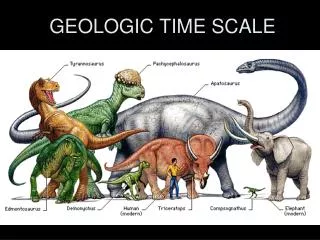
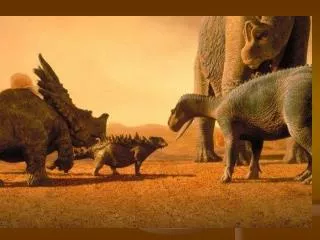
Mesozoic Era • Began 251 million years ago • Surviving reptiles and amphibians evolved into many other species (like dinosaurs) = “Age of Reptiles”
Cretaceous-Tertiary Extinction • Another mass extinction happened 65 million years ago • Marked the end of the Mesozoic Era and the beginning of the Cenozoic Era • All of the dinosaurs and half of the other animals & plants went extinct • Scientists think an asteroid hit Earth, the dust clouds blocked out the sun, plants died, then herbivores, then carnivores.
K-T Boundary- Boundary between Mesozoic and Cretaceous
Cenozoic Era • Began 65 million years ago and continues today • Scientists know the most about this Era because the fossils are in the top rock layers and are easier to find • Land & climate has changed a lot • What big change will happen that will end this era & start the next?