Understanding the Geologic Time Scale: A Visual Representation
This guide provides a step-by-step approach to creating a visual representation of the Geologic Time Scale, detailing the history of Earth as narrated through its geological eras. You will learn to fold and mark paper to create a timeline that includes significant events and organisms from different eras, like the Precambrian, Paleozoic, Mesozoic, and Cenozoic. Each line represents different geological timeframes and evolutionary milestones, making it a fun and educational project to understand Earth’s history better.

Understanding the Geologic Time Scale: A Visual Representation
E N D
Presentation Transcript
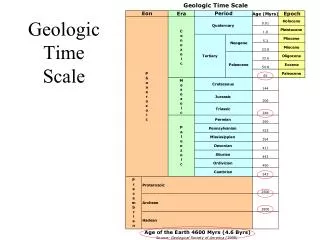
Geologic Time Scale The entire history of the world as told to us by the dirty, filthy rocks
Here's how you make it… • Lay your paper on your table and fold the left edge over by 1 inch (2.5 cm) • Crease the flap and then open it up. • Coloque su papel en su mesa y doblar el borde izquierdo por 1 pulgada (2.5 cm) • Crease la solapa y luego abrirlo. 1 inch or2.5 cm
Here's how you make it… • At the top of your paper, write in the title, “Geologic Time Scale” • Write your name in the top right hand corner. • En la parte superior de su papel, escriba en el título, "Geologic Time Scale" • Escriba su nombre en la esquina superior derecha. Mr. Cruz Geologic Time Scale
Here's how you make it… • Starting 8 cm from the top, draw a horizontal line from the crease • The line should be 14 cm long. • Draw a small dash at the 12.5 cm mark. • A partir de 8 cm de la parte superior, trazar una línea horizontal desde el pliegue • La línea debe ser de 14 cm de largo. • Dibuje un pequeño guión en la marca de 12,5 cm. Mr. Cruz Geologic Time Scale 14 cm 12.5 cm
Here's how you make it… • Make another line 5 cm below your first line. This line will be 16 cm long. • Make dashes at 9 cm and 14.5 cm. • Hacer otra línea de 5 cm por debajo de su primera línea. Esta línea será de 16 cm de largo. • Hacer guiones a los 9 cm y 14,5 cm Mr. Cruz Geologic Time Scale
Here's how you make it… • Draw another line 5 cm below the last line. This line will be 15 cm long. • Draw dashes at 2, 5.5, 7, 9.5, and 13 cm. • Dibuje otra línea de 5 cm por debajo de la última línea.Esta línea será de 15 cm de largo. • Dibuja guiones a los 2, 5.5, 7, 9,5, y 13 cm. Mr. Cruz Geologic Time Scale
Here's how you make it… • Draw another line 5 cm below the last line. This line will be 9 cm long. • Draw dashes at 2 cm and 5 cm. • Dibuje otra línea de 5 cm por debajo de la última línea. Esta línea será de 9 cm de largo. • Dibuja los guiones de 2 cm y 5 cm. Mr. Cruz Geologic Time Scale
Here's how you make it… • Draw another line 5 cm below the last line. This line will be 3.5 cm long. • Make a dash at 3 cm. • Dibuje otra línea de 5 cm por debajo de la última línea. Esta línea será de 3,5 cm de largo. • Hacer un guión de 3 cm. Mr. Cruz Geologic Time Scale
Here's how you make it… • Number each line and write the proper scale: • 1) 1 billion years = 3 cm • 2) 100 million years = 3 cm • 3) 100 million years = 5 cm • 4) 100 million years = 5 cm • 5) 100 million years = 5 cm • Número de cada línea y escribir la escala adecuada:1) 1 mil millones años = 3 cm2) 100 millones años = 3 cm3) 100 millones de años = 5 cm4) 100 millones de años = 5 cm5) 100 millones de años = 5 cm Mr. Cruz Geologic Time Scale 1. 1 billion years = 3cm 2. 100 million years = 3cm 3. 100 million years = 5cm 4. 100 million years = 5cm 5. 100 million years = 5cm
Here's how you make it… • Fold the tab and label each line with the following titles: • Precambrian • The Three Eras • Paleozoic Era • Mesozoic Era • Cenozoic Era • Doble la pestaña de cadalínea y la etiqueta con los siguientestítulos: • Precámbrico • Las tresépocas • Era Paleozoica • Era Mesozoica • Era Cenozoica Mr. Cruz Geologic Time Scale Precambrian The three Eras Paleozoic Era Mesozoic Era Cenozoic Era
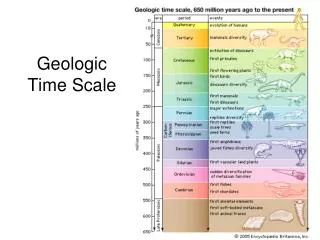
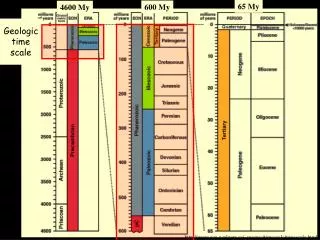
Precambrian Time The 3 Eras (Phanerozoic Eon) 4.6 bya Precambrian Time 544 mya Present • 4.6 bya -- begins when Earth forms from gas and dust (we think) • 4 bya – oceans form • 2.5 bya – organisms begin photosynthesis, makes more oxygen in the atmosphere. • Most organisms were bacteria, algae, or soft-bodied animals
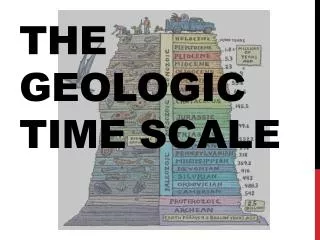
The 3 Eras (Phanerozoic Eon) Present 544 mya 245 mya 66.4 mya Mesozoic Era Cenozoic Era Paleozoic Era Explosion of life Age of the dinosaurs Rise of the mammals
Paleozoic Era • Shallow seas cover much of the land • Explosion of life in seas • Invertebrates with shells appear • Coral reefs develop • Land plants appear • Insects & spiders appear • Winged insects • First true reptiles • N. America & Europe are covered in swamps Cambrian Ordovician Silurian Devonian Carboniferous Permian 544 mya 505mya 438mya 408mya 360mya 286mya 245mya • All continents come together to form one large continent called Pangaea • Reptiles become dominant • Mass extinction kills many marine invertebrates • Ice cap covers North America • Early vertebrates – jawless fish – become common • Age of fishes begins • First amphibians • Forests grow in swampy areas
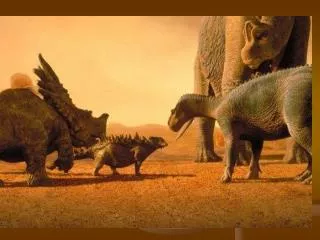
Mesozoic Era Triassic Jurassic Cretaceous 245mya 208mya 144mya 66.4 mya • Age of Reptiles begins • First dinosaurs appear • First mammals appear • Turtles & crocodiles appear • Pangaea continues to break apart • Sea levels rise in many parts of the world • Largest dinosaurs thrive • First birds appears • First flying reptiles appear (pterosaurs) • Widespread volcanic activity • First flowering plants appear • Tyrannosaurus Rex • Mass extinction kills dinosaurs
Cenozoic Era Quarternary Tertiary 66.4mya 1.6mya Present • Age of mammals begins • Whales and dolphins appear • Horses, elephants, bears, rodents, and primates appear • Continents move into present locations. • Human ancestors • Thick glaciers advance in most of N. America & Europe, all of Antarctica, and parts of S. American and Asia. • Giant mammals in N. America & Eurasia • Mr. Cruz is born – the people rejoice!