Download
1 / 3
30 likes | 154 Views
This exploration delves into the significance of fire in early chemistry, tracing its roots from ancient beliefs to alchemical practices. Fire was viewed as a crucial element, symbolizing purification and transformation according to Aristotle. The study of fire and gases became prominent in the 17th and 18th centuries, leading to the formulation of theories such as Becher's "inflammable earth" and Stahl's "phlogiston." Discover how these concepts shaped our understanding of combustion and the chemical processes at play during this revolutionary period in scientific history.

E N D
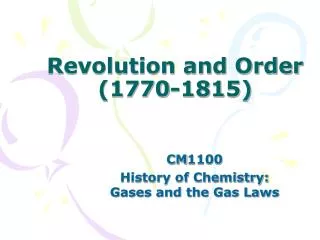
Revolution and Order(1770-1815) CM1100 History of Chemistry: Gases and the Gas Laws
The Genesis of Fire • “And God said: Let there be Fire” (The Ancient Greek word, Phao, means both Light and Fire) • Building on Aristotle’s belief, Fire was regarded as one of the 4 key elements of alchemy • To alchemists Fire represented purification and change • Because of this key role many studies on the nature of Fire were performed in the 17th and 18th century
Flox and Phlogiston • In the early 18th century, Becher suggested that a hypothetical substance, called "inflammable earth“, was contained in every flammable material. It was released in the process of burning leaving the “pure” material (calx) • The released “substance” was later called “PHLOGISTON" (from the Gk word FLOX meaning “flame of fire”) by Stahl