Understanding Carbohydrates: Structure, Function, and Digestion
310 likes | 427 Views
Carbohydrates are energy-yielding nutrients that provide 4 cal/gr. This overview covers their types—monosaccharides (e.g., glucose, fructose), disaccharides (e.g., sucrose, lactose), and polysaccharides (e.g., starch, glycogen). It distinguishes between anabolic and catabolic reactions, with a focus on digestion through enzymes like salivary amylase and pancreatic amylase. The importance of dietary fiber and its categories—soluble and insoluble—is highlighted. Essential for energy, blood glucose maintenance, and digestive health, understanding carbohydrates is crucial for nutrition.


Understanding Carbohydrates: Structure, Function, and Digestion
E N D
Presentation Transcript
Energy Yielding Nutrient • All CHO have a caloric value of 4 cal/gr • Reminder: calorie- measurement of energy • Heat energy needed to raise 1 gr of water 1 degree C
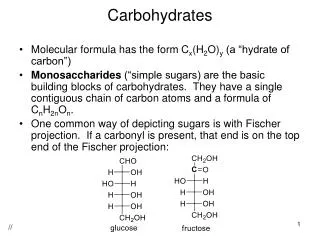
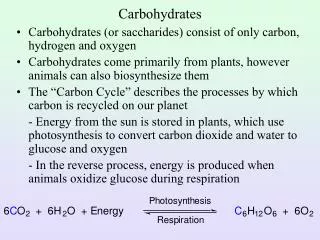
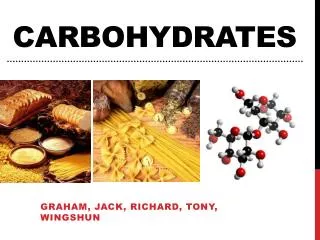
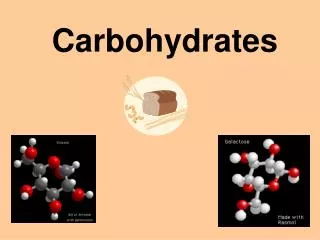
Saccaharides • Monosaccharides: C6H12O6 • The monosaccharides are isomers • Fructose • Galactose • Glucose
Isomers • Def: compounds that have the same chemical formula • Champ and Harvey, Biochemistry. Lippincott. 2nd edition
Dissacharides • Created with the Dehyration Synthesis of Monosaccharides • Anabolic Chemical Reaction • C6H12O6 + C6H12O6 = C12H22O11 + H20 • Hydrolysis is a Catabolic Chemical Reaction
Inquiry Exercise • Differentiate between catabolic and anabolic chemical reactions. • Differentiate between dehydration synthesis and hydrolysis
The Dissacharides • Sucrose(cane sugars) = glc + frc • Lactose(dairy sugars) = glc + gal • Maltose(seed sugars) = glc + glc
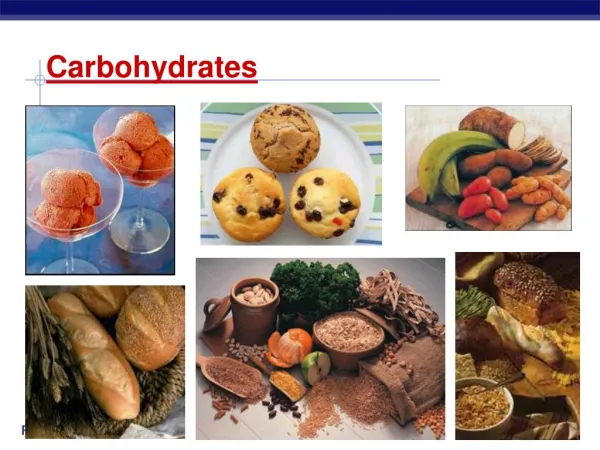
Inquiry Exercise • List six types of grains • List five types of legumes • List three types of tubers
GLYCOGEN • The structural analogue to starches • It is a glucose polymer found in muscle, the liver, stomach and brain • It is synthesized by the liver when we are in a “fed” state • It is released by liver when blood glucose levels drop….”fast” state
Fiber • Fiber is a non-digestible polysacharide. It does not have caloric value • There are two categories: • Soluble • Insoluble
Soluble Fiber • Easily dissolve in water • They are considered heart healthy because they lower blood cholesterol levels • Pectin is an example of soluble fiber
Insoluble fiber • Do not dissolve in water • Promote colon health by promoting bowel movements, lessening constipation and reducing diverticulosis
Dietary Intake • Recommended dietary fiber intake is 25-35g per day
Chemical Digestion Of CHO • Please refer to the digestive system power point in order to understand carbohydrate pathway.
CHO Enzymes • Salivary Amylase: component of saliva • It functions to begin the digestion of polysaccharides • Neutralized by stomach acid
Pancreatic Amylase • Secreted by the exocrine (acini) cells of the pancreas • It enters the duodenum via the pancreatic and common bile ducts • It breaks down polysaccharides into the disaccharides
Duodenal Enzymes • There are three duodenal enzymes: • Sucrase • Lactase • Maltase
Sucrase • Sucrase breaks down sucrose into glucose and fructose • Is this an anabolic or catabolic chemical reaction?
Lactase • Lactase breaks lactose into glucose and galactose. • Lack of lactase production indicates what digestive disorder? What are the symptoms?
Maltase • Breaks down maltose into to glucose molecules
Absorption • All of the monosaccharides are absorbed and transported to the liver. • All monosaccharides can be converted into glucose by the liver because?
Liver • The liver will • Convert monosaccharides into glucose to be part of blood glucose • Create glycogen: glycogenesis • Create lipids: lipogenesis(remember the carbohydrate hypothesis?)
Function(s) of CHO • Energy • Blood glucose • Glycogen
Function(s) of Fiber • Decrease blood cholesterol • Increase bowel movements
Assigned Readings • Figure 4-10 (carbohydrate digestion) p. 104 • pp. 107-111: Blood Glucose • Table 4-2 (alternative sweeteners) pp. 116-117
Acknowledgements • Unless otherwise noted, all information, images and assignments are adapted or taken from • Whitney and Rolfes (2011). Understanding Nutrition. 12 edition. Wadsworth Cengage Learning.