Understanding Faculty Governance and Responsibilities at Gallaudet University
This guide provides essential information for faculty members at Gallaudet University, covering topics related to faculty governance, responsibilities, and evaluation processes. It outlines where to find important documents on MyGallaudet and Blackboard, including faculty bylaws, guidelines, and evaluation criteria. Faculty members can learn about their rights, responsibilities, and the shared governance model at the university. Additionally, it emphasizes the importance of engagement in institutional decision-making and evaluation procedures for teaching, scholarship, and service.


Understanding Faculty Governance and Responsibilities at Gallaudet University
E N D
Presentation Transcript
Faculty Governance Jane Dillehay Faculty Chair
Where to find me? • Jane.dillehay@gallaudet.edu SAC 1229 • Where?? • Behind the Tutorial Center Learning Lab in the Student Academic Center
Two important documentsand where to find them • Use your browser to open MyGallaudetBlackBoard • Scroll down to My Organizations • Organizations in which you are participating • Faculty Governance • University Faculty ByLaws • University Faculty Guidelines • your official contract with the University
http://www.gallaudet.edu/academic_affairs.html • Provost’s home page • Academic Affairs • http://www.gallaudet.edu/Academic_Affairs/Resources.html • Department standards for faculty evaluation • Faculty governance documents • Curriculum forms • Faculty action forms
http://www.gallaudet.edu/x27048.xml • Faculty and Staff • Important information on this web site
Faculty Guidelines • Policies, procedures, and conditions of employment. • Faculty Welfare committee develops amendments to present to the Senate for approval. • In the spirit of shared governance, the University Faculty works with the Administration to develop proposals for amendments. • The Board of Trustees has final approval of amendments.
Guideline topics • Faculty responsibilities • Academic rank • Faculty appointments • Faculty evaluation • Faculty personnel actions • Faculty leaves • Salaries and compensation • Faculty recruitment • Grievances and appeals
Types of faculty • Tenure track and tenured • Non tenure track • Full time temporary • Adjuncts (part time temporary)
Faculty evaluation • Currently evaluation covers: • Teaching • Scholarship/creative activities/research • Service • ASLPI (ASL Proficiency Interview and multiple measures) • Professional integrity • New faculty evaluation system in progress and under review by Faculty Welfare this year
When is your first faculty evaluation? • At the end of your first semester! • Due to the dean by February 1st • Who evaluates you? • Your department faculty and chairperson
What about faculty hired in January? • Section 6.4.3 recognizes these faculty as continuing first year faculty in the following August. • Your letter of hire should be explicit about: • Evaluation process • Terms of employment • Years of countable service
Time for some practical advice • Meet with your chairperson – develop a workplan • Ask for a faculty mentor • Documentall of your activities for your self report for evaluation • Create folders online or in your files for: • Teaching • Scholarship • Service
Expectations for teaching • Guidelines 2.1.2.1 and 4.1.1.5 • Full load = 3 courses (up to 3 different preps) or 4 courses (maximum 2 different preps) • Departments can develop more precise workload formula in consultation with Dean • 3 to 4 courses = 9 to 15 hours in classroom • Office hours (department standards) • Time for course preparation
Expectations for scholarship • Guidelines 2.1.2.2 and dept standards • Year 1 – map a plan with your chairperson • Year 2 – implement your plan • Year 3 – have products for evaluation - presentations - publications - grants - exhibits - other products
Expectations for service • Guidelines 2.1.2.3 and department standards • You are encouraged to serve on a faculty governance standing committee • Elections for committees in April 2013 for the next year • Other service? • Department and/or university • Students • Community - Professional
Guidelines Section 6 6.0 Evaluation 6.1 Purposes of Evaluation 6.2 Areas for Evaluation 6.3 Scope 6.4 Frequency 6.5 Criteria for Evaluation 6.6 Documentation 6.7 Procedures 6.8 Multiple Measures of ASL Proficiency/Classroom Communication
Guidelines Section 7 7.0Faculty Personnel Actions 7.1 Procedures and Notification 7.2 Reappointments and Non‑reappointments 7.3 Merit Increases 7.4 Promotion 7.5 Tenure
Faculty ByLaws • http://www.gallaudet.edu/Documents/Provost/Faculty/Bylaws_of_the_University_Faculty_2010.pdf • Shared governance • University Faculty membership • Faculty governance structure
Shared governance – faculty responsibilities • Teaching and research • Decisions on issues directly related to teaching/research: -choice of research methodology; -choice of instructional strategy; -choice of subject matter to be taught or researched; -policies for admitting students; -standards of student competence within a discipline of study; -the maintenance of a suitable environment for learning; and -standards of faculty competence.
Shared governance cont’d Faculty must be involved in institutional decision making because this can affect teaching and research. Examples: • Long-range objectives (Strategic Plan) • Physical and fiscal resources (University Planning and Budget Committee) • Resource allocation among the university divisions • The search and selection of the president and chief academic officer (Provost).
Shared governance is founded on: • Faculty authority for teaching and research as a necessary condition for academic freedom • Recognition of teaching and research as central to the functions of the university • Faculty participation in institutional decision making to support the university's mission and strategic plan.
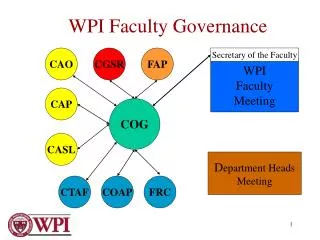
Faculty Governance structure • University Faculty Senate • Two Legislative Councils for curriculum - Graduate and Undergraduate • Standing committees – • Faculty Welfare • Faculty-Student Affairs • Grievances • Salary and Benefits • Faculty Development • Tenure and Promotion
AAUP American Association of University Professors • Advance academic freedom and shared governance • Define fundamental professional values and standards for higher education • Ensure higher education's contribution to the common good.
Current Issues • Restructuring of Academic Affairs • Faculty Evaluation and Compensation
Concerns or Questions about Your Rights? • Contact: • Faculty Chair • Chair of Faculty Welfare committee • Executive Committee of the Gallaudet Chapter of the AAUP • CristiBerdichevsky • Robert Harrison • Marguerite Glass • Emilia Chukwuma • Chris Heuer • Teresa Burke