Download
1 / 17
170 likes | 296 Views
This document provides an in-depth look at Charge-Coupled Devices (CCDs), detailing how their capacitance affects operation and image capture. It covers key principles such as capacitance calculation, electron charge transfer, and the role of light exposure in charge accumulation. The document also includes practical examples and calculations involving voltage, charge on capacitors, and photon interaction, giving insights into CCD resolution and magnification. Suitable for those looking to understand digital imaging technology in detail.

E N D
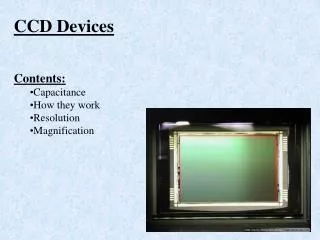
CCD Devices • Contents: • Capacitance • How they work • Resolution • Magnification
Concept 0 - Capacitance • C = q • V • C = capacitance (Farads) • q = Charge on the capacitor (C) • V = voltage across the capacitor (V) demo big cap + + + + + + + + + + + + + + + + + + + + + + + + + + + + + + + + + + + + + + + + + + + + - - - - - - - - - - - - - - - - - - - - - - - - - - - - - - - - - - - - - - - - - - - - - - - - - - - - - - - - - - - - - - A CCD pixel has a capacitance of 1.7x10⁻¹² F. What is the voltage across it if it has been charged 6.0x10⁴ electron charges? (1 e = 1.602E-19) V = q/C = (6.0E11*1.602E-19/1.7E-16) = 5.7 mV TOC
Whiteboards: Capacitance 1 | 2 | 3 TOC
What is the charge on a 250 microfarad capacitor if it has been charged to 12 V? q = CV = (250E-6 F)(12 V) = 3E-3 Coulombs W .0030 C
What is the capacitance of a CCD pixel if it has .014 V across it when it has a charge of 2.13x10⁻¹⁵ C? C = q/V = (2.13E-15 C)/(.014 V) = 1.52x10⁻¹³ F W 1.52x10⁻¹³ F
Example: A 3.1x10⁻¹⁰ m2 CCD pixel has a capacitance of 2.3 pF (x10-12) If after being exposed to light, it has picked up a charge of 3.45x10⁻¹⁴ C, what is the voltage across it? How many electrons were displaced from the pixel? If photons displaced these electrons, then what is the photon flux in photons/m2 incident on the CCD? (e = 1.602E-19 C/electron) V = q/C = (3.45E-14C )/(2.3E-12 F) = .015 V # electrons = (3.45E-14C )/(1.602E-19 C/electron) = 2.154E5 electrons photons/m2 = (2.154E5 electrons)/(3.1E-10 m2) = 6.95E14 photons/m2 A sunny day = about 1000 W/m2≈ 3x10²¹ photons/sec (550 nm) (a force of 3.3x10⁻⁶ N/m2 W 0.015 V 2.2E5 electrons 6.9E14 photons/m2
How a CCD Works (Charge-Coupled Device) • Photons charge electrodes • Voltages from pixels is shifted off the chip • The voltage is converted to digital TOC www.microscopy.fsu.edu/primer/digitalimaging/concepts/ccdanatomy.html
How a CCD Works CCDs only register light, color is achieved using filters TOC www.microscopy.fsu.edu/primer/digitalimaging/concepts/ccdanatomy.html
jpeg compression photon memory card
Resolution, sensor size and magnification Nikon D3x: (CMOS) Sensor size = 35.9x24.0 mm = 861.6 mm2 6048x4032 resolution = 24 Mega pixels Human eye: (rods and cones) Sensor size = 1100 mm2 11,000x11,000 = 121 Mega Pixels Magnification: image/object ratio Nikon D3x TOC
Resolution, sensor size and magnification Nikon D3x: (CMOS) Sensor size = 35.9x24.0 mm = 861.6 mm2 6048x4032 resolution = 24 Mega pixels (Let’s assume a quantum efficiency of 70%) A) What is the area of each pixel? B) If light with a photon flux of 4.5x10¹⁹ photons/m2/s is incident on the sensor for 1/250th of a second, what is the resulting charge on the pixel? C) If the voltage across the pixel is 2.4 mV, what is the capacitance of the pixel? D) If I am 183 cm tall, and my image on the sensor is 19.2 mm tall, what is the “magnification” in this case? TOC
Nikon D3x: (CMOS) • Sensor size = 35.9x24.0 mm = 861.6 mm2 • 6048x4032 resolution = 24 Mega pixels • (Let’s assume a quantum efficiency of 70%) • A) What is the area of each pixel? • total area = (35.9E-3m)x(24.0E-3) = 0.0008616 m2 • #pixels = 6048x4032 = 24,385,536 pixels • area/pixels = (0.0008616 m2)/(24,385,536 pixels) = 3.53324E-11 m2/pixel • B) If light with a photon flux of 4.5x10¹⁹ photons/m2/s is incident on the sensor for 1/250th of a second, what is the resulting charge on the pixel? • Photons per pixel resulting in charge = • (0.70)(4.5x10¹⁹ photons/m2/s)(1 s/250)(3.53324E-11 m2/pixel) = 4451884.921 • e charges per pixel • So this is (4451884.921)(1.602E-19) =7.13192E-13 C • C) If the voltage across the pixel is 2.4 mV, what is the capacitance of the pixel? • C = q/V = (7.13192E-13 C)/(2.4E-3 V) = 2.97163E-10 F = 297 pF • D) If I am 183 cm tall, and my image on the sensor is 19.2 mm tall, what is the “magnification” in this case? • image/object = (1.92 cm)/(183 cm) = .0105x (it’s a smallifier) TOC
Whiteboards: Random CCD Crap 1 | 2 | 3 | 4 TOC
My camera has a 25.4 mm x 58.4 mm CCD sensor with 4.0 Mega pixels. What is the area of each pixel in square meters? Area per pixel = (25.4E-3 m)(58.4E-3 m)/(4.0E6) = 3.7084E-10 m2 W 3.7084E-10 m2
A pixel builds up a potential of 5.2 mV. How many photons hit it if it has a capacitance of 13 pF, and a quantum efficiency of 75%? q = CV = (13E-12F)(5.2E-3) = 6.76E-14 C # electrons = 421,972 #electrons/#photons = .75, #photons = (421,972)/.75 = 562,630 W 560,000 photons
A single pixel with an area of 3.7x10⁻¹⁰ m2 is hit with 562,630 photons. What is the light intensity in photons/m2? photons/m2 = (562,630)/(3.7x10-10 m2) = 1.5E+15 W 1.5x10¹⁵ photons/m2