Chapter 3 Atoms and Elements
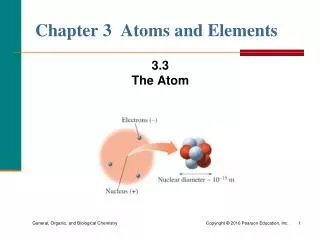
Chapter 3 Atoms and Elements. 3.3 The Atom. Dalton’s Atomic Theory. Atoms are tiny particles of matter of an element are similar to each other but are different from atoms of other elements of two or more different elements combine to form compounds

Chapter 3 Atoms and Elements
E N D
Presentation Transcript
Chapter 3 Atoms and Elements 3.3The Atom
Dalton’s Atomic Theory Atoms • are tiny particles of matter • of an element are similar to each other but are different from atoms of other elements • of two or more different elements combine to form compounds • are rearranged to form new combinations in a chemical reaction
Subatomic Particles Atoms contain subatomic particles. • Protons have a positive (+) charge. • Electrons have a negative (–) charge. • Like charges repel, and unlike charges attract. • Neutrons are neutral.
Rutherford’s Gold-Foil Experiment In Rutherford’s gold-foil experiment, positively charged particles • were aimed at atoms of gold • mostly went straight through the atoms • were deflected only occasionally Conclusion: There must be a small, dense, positively charged nucleus in the atom that deflects positive particles that come close.
Structure of the Atom An atomconsists • of a nucleus that contains protons and neutrons • of electrons in a large, empty space around the nucleus
Atomic Mass Scale On the atomic mass scale for subatomic particles: • 1 atomic mass unit (amu) is defined as 1/12 of the mass of the carbon-12 atom. • A proton has a mass of about 1 (1.007) amu. • A neutron has a mass of about 1 (1.008) amu. • An electron has a very small mass, 0.000549 amu.
Learning Check Identify each statement as describing a(n) 1) proton, 2) neutron, or 3) electron. A. __ found outside the nucleus B. __ has a positive charge C. __ is neutral D. __ found in the nucleus
Solution Identify each statement as describing a(n) 1) proton, 2) neutron, or 3) electron. A. 3 found outside the nucleus B. 1 has a positive charge C. 2 is neutral D. 1, 2 found in the nucleus