Efficient IP Addressing and Subnetting for Enhanced Scalability and Forwarding
This document provides an in-depth analysis of IP addressing and subnetting, emphasizing the importance of efficient address allocation for routers. It explains how hierarchical addressing helps manage large networks, addressing scalability by allowing the addition of hosts without extensive router updates. The role of Regional Internet Registries (RIRs) and the Internet Assigned Numbers Authority (IANA) in coordinating IP addresses is detailed. The text also discusses the limitations of IPv4 and the need for transitioning to IPv6, alongside various strategies for optimizing current address usage.

Efficient IP Addressing and Subnetting for Enhanced Scalability and Forwarding
E N D
Presentation Transcript
Efficient IP Addressing Subnetting
forwarding table Review: IP Addressing • Suppose hosts had arbitrary addresses • Then every router would need a lot of information • …to know how to direct packets toward the host 1.2.3.4 5.6.7.8 2.4.6.8 1.2.3.5 5.6.7.9 2.4.6.9 ... ... host host host host host host LAN 2 LAN 1 router router router WAN WAN 1.2.3.4 1.2.3.5
Review: IP Addressing scalability • Number related hosts from a common subnet • 1.2.3.0/24 on the left LAN • 5.6.7.0/24 on the right LAN 1.2.3.4 1.2.3.7 1.2.3.156 5.6.7.8 5.6.7.9 5.6.7.212 ... ... host host host host host host LAN 2 LAN 1 router router router WAN WAN 1.2.3.0/24 5.6.7.0/24 forwarding table
Review: Scalability- Adding new hosts • No need to update the routers • E.g., adding a new host 5.6.7.213 on the right • Doesn’t require adding a new forwarding entry 1.2.3.4 1.2.3.7 1.2.3.156 5.6.7.8 5.6.7.9 5.6.7.212 ... ... host host host host host host LAN 2 LAN 1 router router router host WAN WAN 5.6.7.213 1.2.3.0/24 5.6.7.0/24 forwarding table
Some Questions: IP Addressing • How are IP addresses managed • Given out • Single point • Hierarchical • Documentation • Record of what is given out and to whom • Accounting • What remains?
Giving out: Obtaining a Block of Addresses • The Internet Assigned Numbers Authority (IANA) is responsible for the global coordination of IP addressing, and other Internet protocol resources • Internet Corporation for Assigned Names and Numbers (ICANN) • Allocates large address blocks to Regional Internet Registries • Regional Internet Registries (RIRs) • Allocates address blocks within their regions • Allocated to Internet Service Providers and large institutions • Internet Service Providers (ISPs) • Allocate address blocks to their customers • Who may, in turn, allocate to their customers… • Prefix: assigned to an institution • Addresses: assigned by the institution to their nodes
Regional Internet Registries • Five RIRs to cater to five large global regions • African Network Information Centre (AfriNIC)for Africa • American Registry for Internet Numbers (ARIN)for the United States, Canada, and several parts of the Caribbean region. • Asia-Pacific Network Information Centre(APNIC)for Asia, Australia, and neighboring countries • Latin America and Caribbean Network Information Centre(LACNIC)for Latin America and parts of the Caribbean region • RIPE NCC (RIPE NCC) for Europe, the Middle East, and Central Asia
Record: Figuring Out Who Owns an Address • Address registries • Public record of address allocations • Internet Service Providers (ISPs) should update when giving addresses to customers • However, records are notoriously out-of-date • Ways to query • http://www.db.ripe.net/whois to find RIPE NCC database for IP addresses • http://www.geektools.com/whois.php • …
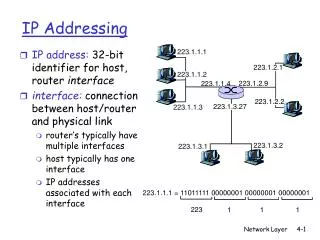
Are 32-bit Addresses Enough? • Not all that many unique addresses • 232 = 4,294,967,296 (just over four billion) • Plus, some are reserved for special purposes • And, addresses are allocated in larger blocks • And, many devices need IP addresses • Computers, PDAs, routers, tanks, toasters, … • Long-term solution: a larger address space • IPv6 has 128-bit addresses (2128 = 3.403 × 1038) • Short-term solutions: limping along with IPv4 • Private addresses • Network address translation (NAT) • Dynamically-assigned addresses (DHCP)
Hard Policy Questions • How much address space per geographic region? • Equal amount per country? • Proportional to the population? • What about addresses already allocated? • Address space portability? • Keep your address block when you change providers? • Keeping the address registries up to date? • What about mergers and acquisitions? • Delegation of address blocks to customers? • As a result, the registries are horribly out of date
What the IP Address Meltdown Means For You Article in PC world: posted on Dec 1, 2010 5:39 pm: Brief synopsis • The world is running out of IPv4 Internet addresses, without which the Internet can't function in its existing form. • This has been known for some time, of course, but the situation has become a little more urgent with the news that in October and November, nearly all of the remaining blocks of addresses were assigned to various Regional Internet Registries (RIR) around the world……. • Remaining five blocks of IP addresses given out by beginning of 2011 to the five RIRs…..
Objectives • Economising IP address use: • To subnet an IP Address from given network requirements • Why subnet • Hierarchy in subnetted addresses • How to subnet • Identify network class • Identify network requirements • Calculate sub-network addresses • Calculate available host addresses • Calculate new subnet mask • Assign new addresses
Advantages of Subnetting • With subnetting, IP addresses use a 3-layer hierarchy: • Network • Subnet • Host • Improves efficiency of IP addresses by not consuming an entire address space for each physical network. • Reduces router complexity. Since external routers do not know about subnetting, the complexity of routing tables at external routers is reduced. • Note: Length of the subnet mask need not be identical at all subnetworks.
Subnetting Subnetting University Network • Problem: Organizations have multiple networks which are independently managed • Solution 1: Allocate one or more addresses for each network • Difficult to manage • From the outside of the organization, each network must be addressable. • Solution 2: Add another level of hierarchy to the IP addressing structure Engineering School Medical School Library
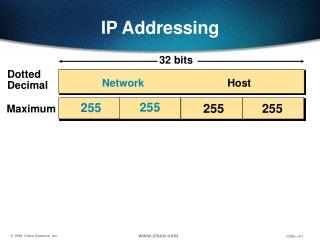
Two-level hierarchy • The network prefix identifies a network and the host number identifies a specific host (actually, interface on the network). • How do we know how long the network prefix is? • The network prefix is implicitly defined using class-based addressing • The network prefix is indicated by a subnet mask or netmask network prefix host number
Subnetting- Three level Hierarchy • Split the host number portion of an IP address into a subnet number and a (smaller) host number. • Result is a 3-layer hierarchy • Then: • Subnets can be freely assigned within the organization • Internally, subnets are treated as separate networks • Subnet structure is not visible outside the organization network prefix host number network prefix subnet number host number extended network prefix
Typical Addressing Plan for an Organization that uses subnetting • Each layer-2 network (Ethernet segment, FDDI segment) is allocated a subnet address. 128.143.0.0/16
Advantages of Subnetting • With subnetting, IP addresses use a 3-layer hierarchy: • Network • Subnet • Host • Improves efficiency of IP addresses by not consuming an entire address space for each physical network. • Note: Length of the subnet mask need not be identical at all subnetworks.
Task: Create subnetwork addresses Create subnetwork addresses for 20 different network addresses, using IP address 201.222.5.0 sales Admin
Convert the decimal dotted notation address 201.222.5.0 to binary: STEP 1: Convert the decimal dotted notation 11001001.11011110.00000101.00000000
Determine the Class of the IP Address 201.222.5.0: Step 2: Class of the IP Address CLASS C
Based on the Class, determine what part of the IP address is the network portion and what part of the address is the host portion:201.222.5.0 Step 3. Find Network portion and Host portion 11001001.11011110.00000101.00000000 Network .Network .Network .Host 201. 222. 5. 0
Determine how many bits you need to borrow from the last octet (host portion) of the IP Address to give you the needed 20 subnets: Step 4: How many bits to borrow 2 to the power of 2 = 4 subnets (less 2) 2 to the power of 3 = 8 subnets (less 2) 2 to the power of 4 = 16 subnets (less 2) 2 to the power of 5 = 32 subnets (less 2) 2 to the power of 6 - 64 subnets (less 2)
Since you borrowed five bits from the host for subnets, determine how many hosts can you have on each of those subnets? Step 5: Determine how many hosts can you have on each of those subnets 2 to the power of 3 = 8 hosts (less 2) giving you 6 hosts per subnet. 11001001.11011110.00000101.00000000 Remaining bits = Number of hosts
Determine the Subnetworks’ Numbers from the borrowed 5 bits: 32 possible combinations Step 6: Determine the Binary Subnetworks Field Numbers Subnet # Binary Subnetwork 1 00000 2 00001 3 00010 4 00011 5 00100 6 00101 7 00110 8 00111 9 01000 10 01001 11 01010 12 01011 13 01100 .. …….. 32 11111
Step 7: Determine the Range of Binary Host Field Numbers for Each Subnetwork: Determine the Range of Binary Host Field Numbers for Each Subnetwork: 3 bits: 8 possible hosts on each subnet Subnet # Binary Subnetwork Range of Host #’s 1 00000 2 00001 000 - 111 3 00010 000 - 111 4 00011 000 - 111 5 00100 000 - 111 6 00101 000 - 111 7 00110 000 - 111 8 00111 000 - 111 9 01000 000 - 111 12 01100 000 - 111 .. …….. ----------- 32 11111
Step 8: Determine Decimal Host Numbers for Each Subnetwork Subnet # Binary Subnetwork Range of Host #’s Decimal Host Numbers 1 00000 2 00001 000 - 111 .8 - .15 3 00010 000 - 111 .16 - .23 4 00011 000 - 111 .24 - .31 5 00100 000 - 111 .32 - .39 6 00101 000 - 111 .40 - .47 7 00110 000 - 111 .48 - .55 8 00111 000 - 111 .56 - .63 9 01000 000 - 111 .64 - .71 10 01001 000 - 111 .72 - .79 11 01010 000 - 111 .80 - .87 12 01011 000 - 111 .88 - .95 13 01100 000 - 111 .96 - 103 .. …….. ----------- ---------- 32 11111
Step 9. Determine Our Subnet Addresses: #Binary Subnetwork Range of Host #’s Subnet Address 1 0000 0000 2 0000 1000 201.222.5.8 3 000 1 0 000 201.222.5.16 4 0001 1000 201.222.5.24 5 0010 0000 201.222.5.32 6 0010 1000 201.222.5.40 7 0011 0000 201.222.5.48 8 0011 1000 201.222.5.56 9 0100 0000 201.222.5.64 10 0100 1000 201.222.5.72 11 0101 0000 201.222.5.80 12 0101 1000 201.222.5.88 13 0110 0000 201.222.5.96 .. .……. ----------- ---------- --------------- 32 1111 1000
Step 10. Determine Host Addresses of the Six Nodes of Each Subnet: #SubnetworkRange of Host #’sDecimal Host #’s Subnet AddressHost Address Range 1 00000 2 00001 000 - 111 .8 - .15 201.222.5.8 201.222.5.9 thru 201.222.5.14 3 00010 000 - 111 .16 - .23 201.222.5.16 201.222.5.17 thru 201.222.5.22 4 00011 000 - 111 .24 - .31 201.222.5.24 201.222.5.25 thru 201.222.5.30 5 00100 000 - 111 .32 - .39 201.222.5.32 201.222.5.33 thru 201.222.5.38 6 00101 000 - 111 .40 - .47 201.222.5.40 201.222.5.41 thru 201.222.5.46 7 00110 000 - 111 .48 - .55 201.222.5.48 201.222.5.49 thru 201.222.5.54 8 00111 000 - 111 .56 - .63 201.222.5.56 201.222.5.57 thru 201.222.5.62 9 01000 000 - 111 .64 - .71 201.222.5.64 201.222.5.65 thru 201.222.5.70 10 01001 000 - 111 .72 - .79 201.222.5.72 201.222.5.73 thru 201.222.5.78 11 01010 000 - 111 .80 - .87 201.222.5.80 201.222.5.81 thru 201.222.5.86 12 01011 000 - 111 .88 - .95 201.222.5.88 201.222.5.89 thru 201.222.5.94 13 01100 000 - 111 .96 - 103 201.222.5.96 201.222.5.97 thru 201.222.5.-- .. .……. ----------- ---------- --------------- ------------------------------------- 32 11111
Based on the Class, determine the subnet mask for network 201.222.5.0 (remember that 5 bits were borrowed): Step 12: Find New Subnet mask 11111111.11111111.11111111.11111 000 Network NetworkNetwork Subnet Host 255. 255. 255. 248
African Network Information Centre (AfriNIC)[1] for Africa • American Registry for Internet Numbers (ARIN)[2] for the United States, Canada, and several parts of the Caribbean region. • Asia-Pacific Network Information Centre (APNIC)[3] for Asia, Australia, and neighboring countries • Latin America and Caribbean Network Information Centre (LACNIC)[4] for Latin America and parts of the Caribbean region • RIPE NCC[5] for Europe, the Middle East, and Central Asia