
Exploring DNA Discoveries: History and Structure Insights
E N D
Presentation Transcript
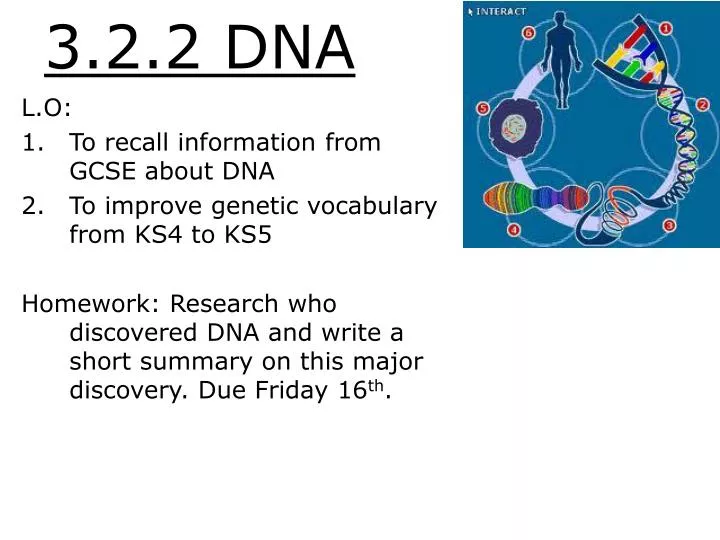
3.2.2 DNA L.O: • To recall information from GCSE about DNA • To improve genetic vocabulary from KS4 to KS5 Homework: Research who discovered DNA and write a short summary on this major discovery. Due Friday 16th.
What do you know about DNA? • In small groups, using the picture as an aid, write as much as you know about DNA on the A3 sheet. • Highlight any keywords, can you get more than 10? • What point on your sheet do you think is the most important? Put a ‘*’ next to it
Share the knowledge! • Swap sheets • In 60 seconds, add as much detail as possible to their poster
Add to your knowledge! • http://www.youtube.com/watch?v=FUA6_Ucw3i4
Nucleotides! This is a MONONUCLEOTIDE, if you joined two together what would you get? And then many? And how would they join? Basic structure… Deoxyribose
Nucleotides! This is a MONONUCLEOTIDE, if you joined two together what would you get? And then many? And how would they join? Basic structure… Two = dinucleotide. Many = polynucleotide. Join together by a condensation reaction. Deoxyribose
5) Remember that A pairs with T, and G pairs with C Questions to think about… What do you notice about the directions the nucleotides on each side? Why do you think the bases (A T C G) are on the inside?
The strands are anti-parallel (go in two different directions)
The strands are anti-parallel (go in two different directions) Sugar – phosphate backbone
The strands are anti-parallel (go in two different directions) 2 hydrogen bonds between A and T Sugar – phosphate backbone 3 hydrogen bonds between G and C
The strands are anti-parallel (go in two different directions) DNA is a stable molecule of hereditary 2 hydrogen bonds between A and T Sugar – phosphate backbone 3 hydrogen bonds between G and C
Plenary • What do you know now that you didn’t know 60 mins ago? • How could you best demonstrate your new knowledge about DNA? • What do you think we might learn next lesson?