Congestion Estimation in Floorplanning Supervisor: Evangeline F. Y. YOUNG
290 likes | 390 Views
This paper presents congestion modeling in floorplanning to optimize interconnects, reduce wirelength, and enhance routability. Different congestion models are discussed along with experimental results and insights for future work.


Congestion Estimation in Floorplanning Supervisor: Evangeline F. Y. YOUNG
E N D
Presentation Transcript
Congestion Estimation in Floorplanning Supervisor: Evangeline F. Y. YOUNG by Chiu Wing SHAM
Overview • Introduction • Background • Congestion Modeling • Experimental Results • Future Works
Introduction • Motivations: • 80% of the clock cycle consumed by interconnects • Interconnect optimization becomes the major concern in floorplanning • Appropriate interconnect estimation is required in floorplanning
Major Role of Floorplanning • Minimization of chip area • Optimization of interconnect cost • Wirelength • Timing delay • Routability • Others: • Heat dissipation • Noise reduction • Power consumption
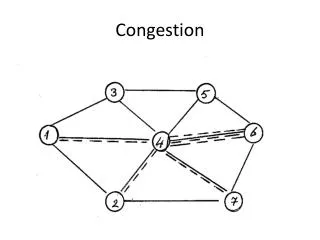
Congestion Planning • Congestion planning is important to circuit design • Excessive congestion may result in a local shortage of routing resources • A large expansion in area • Failure in achieving timing closure • Congestion modeling • Given a packing and netlist • Estimating the congestion and routability instead of real routing
Congestion Model A The probability that wire k passing through this grid, Pk(x,y) =4/6 =0.67
Congestion Model A Congestion of the grid (x,y) - Expected number of wires passing through the grid (x,y), weight(x,y):
Limitations • Model A assumes that all feasible routes have the same probability of being selected • In real cases, the routes with less bends should have a higher probability of being selected The probability that wire k passing through this grid, Pk(x,y) =8/24 =0.33
Congestion Model B where distk(x, y) is the distance from the source of wire k to the grid (x, y) and cntk(r) is the number of grids in the division that is r grids from the source. Congestion of the grid (x,y) due to wire k - the probability of wire k pass through the grid (x,y), Pk(x,y):
Limitations • Routing resources: • Both models assume that routing resources are equal at different locations • Routing resources should be different at different locations in real cases • Wirelength: • Both models assume that all nets are routed in their shortest Manhattan distance • Some nets may be routed with detours in real cases
Our Approaches • Congestion Model A*: • Based on model A • Routing resources can be different at different locations • Congestion Model B*: • Based on model B • Routing resources can be different at different locations • Congestion Model C: • Based on model B* • Routing resources can be different at different locations • Each net may be routed with detours
Congestion Model A* • Considering routing resources
Congestion Model A* • Notations: • res(x,y): relative routing resources at the grid (x, y) • Lk(x,y): the set of feasible routes for wire k passing through the grid (x,y) • Lk: the set of all feasible routes for wire k • Gk(l): the set of grids that the route l of wire k will pass through • wk(l): the weight of each feasible route l • Equations:
Congestion Model B* • Considering routing resources
Congestion Model B* • Notations: • res(x,y): relative routing resources at grid (x, y) • distk(x,y): the distance from the source of wire k to the grid (x,y) • divk(r): the set of grids that are r grids from the source of wire k • Equation
Congestion Model C • Considering routing resources • Each net may be routed with detours
Congestion Model C • Notations: • res(x,y): relative routing resources at the grid (x, y) • dist(x,y): the distance from the the grid (0, 0) to the grid (x,y) • divk(r): the set of grids that are r grids from the grid (0,0) of wire k • CRk: the set of divisions located in the compulsory region • ORk: the set of divisions located in the optional region • : degrade factor for the grids outside the SMB region • : degrade factor for the grids in the optional region • d(i, j, k, l): the distance between the grid (i, j) and (k, l)
Congestion Model C Equation: Compulsory Region (divk(dist(x, y)) CRk): Optional Region (divk(dist(x, y)) ORk):
Implementation • Floorplanning: • Representations: SP • Heuristics: Simulated Annealing • Cost function: Weighted sum of wirelength and number of over-congested grid • Routing • Cadence’s WROUTE
Experimental Results Test cases:
Future works • Limitations of congestion model C • Too many parameters (, ) are used • Longer running time • Limitations of representation • Packed closely together