Exploring the Anomalous Hall Effect in Abrupt Magnetization Reversal of Fe1/4TaS2
This study delves into the oddities of electron motion in ferromagnets, particularly focusing on the anomalous Hall effect (AHE). While electronic movement typically showcases time-reversal symmetry, this symmetry fails in ferromagnetic materials due to aligned spins, leading to noticeable changes in current behavior. Researchers identified a novel ferromagnet, Fe1/4TaS2, showing sharp magnetization reversals under varying magnetic fields. This characteristic enables precise measurement of AHE, revealing significant scaling relationships with resistivity, which could enhance our understanding of spin-aligned material behaviors.

Exploring the Anomalous Hall Effect in Abrupt Magnetization Reversal of Fe1/4TaS2
E N D
Presentation Transcript
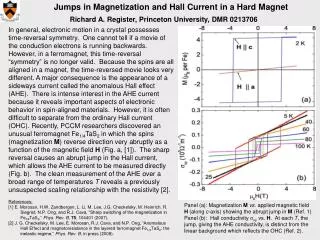
Jumps in Magnetization and Hall Current in a Hard Magnet Richard A. Register, Princeton University, DMR 0213706 In general, electronic motion in a crystal possesses time-reversal symmetry. One cannot tell if a movie of the conduction electrons is running backwards. However, in a ferromagnet, this time-reversal “symmetry” is no longer valid. Because the spins are all aligned in a magnet, the time-reversed movie looks very different. A major consequence is the appearance of a sideways current called the anomalous Hall effect (AHE). There is intense interest in the AHE current because it reveals important aspects of electronic behavior in spin-aligned materials. However, it is often difficult to separate from the ordinary Hall current (OHC). Recently, PCCM researchers discovered an unusual ferromagnet Fe1/4TaS2in which the spins (magnetization M) reverse direction very abruptly as a function of the magnetic field H (Fig. a, [1]). The sharp reversal causes an abrupt jump in the Hall current, which allows the AHE current to be measured directly (Fig. b). The clean measurement of the AHE over a broad range of temperatures T reveals a previously unsuspected scaling relationship with the resistivity [2]. References: [1] E. Morosan, H.W. Zandbergen, L. Li, M. Lee, J.G. Checkelsky, M. Heinrich, R. Siegrist, N.P. Ong, and R.J. Cava, “Sharp switching of the magnetization in Fe1∕4TaS2,” Phys. Rev. B, 75, 104401 (2007). [2] J. G. Checkelsky, M. Lee, E. Morosan, R.J. Cava, and N.P. Ong, “Anomalous Hall Effect and magnetoresistance in the layered ferromagnet Fe1/4TaS2: the inelastic regime,” Phys. Rev. B, in press (2008). Panel (a): Magnetization Mvs. applied magnetic field H (along c-axis) showing the abrupt jump in M (Ref. 1) Panel (b): Hall conductivity sxy vs. H. At each T, the jump, giving the AHE conductivity, is distinct from the linear background which reflects the OHC (Ref. 2).