Download
1 / 46
470 likes | 547 Views
Explore three pivotal eras of Russian history: Tsarist Russia, the Soviet Union, and Presidential Democracy. Discover the country's geography, government, and major events such as the rise of the Russian monarchy and the Russian Revolution.

E N D
Russia Three eras of Russian history: Tsarist Russia (13th century-1917) Communist USSR (1920-1993 ish) Presidential Democracy ish (1993- present)
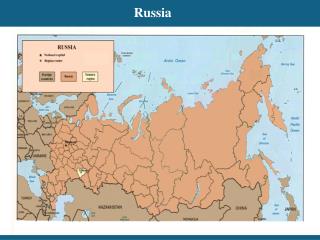
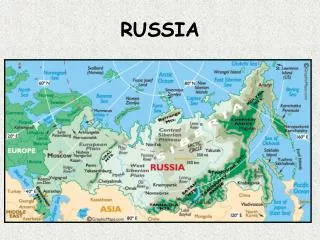
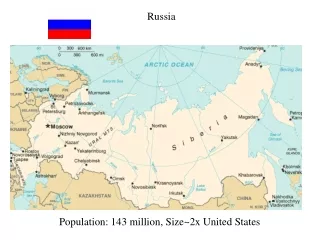
Geography • Europe or Asia? • 11 time zones • Few natural boundaries • Not much arable land • Difficulty in reaching the sea (warm water ports) • Isolated (more than just geographically) • Based on its geography, how do you predict its government would develop?
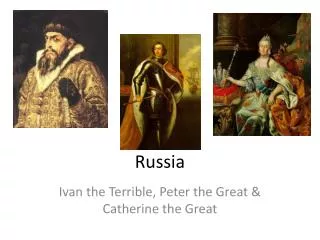
Early Russia • Who are the Russians? • Slovak, slavic: is this enough to unite a people? • 13th Century: The Mongols • Rise of the duchy of Moscow: Ivan the Terrible • Took centuries for Russia to catch up with Europe
Slavs and ethnicity • What problems do you think Russia will encounter concerning ethnicity? • How do you think Russia has dealt with ethnic differences? • What problem would different languages cause in a country?
The Russian monarchy • Ivan had a secret police that would exile or execute those that opposed him (boyars) • Tradition of strong, ruthless leadership • Cyrillic alphabet, few educated • Eastern Orthodox (the Third Rome) (tsars are the head of the church) • 15th and 16th century: free peasants became serfs? • Time of Troubles (17th century)
Peter: top down modernization • Peter the Great: comes to power in 1682 • Little bit controlling (military, legislation, war, technology) • Built St. Petersburg • Created provinces, counties and districts • Conscription • Taxation
Gun Powder empire- powerful in the 1700s • Under Peter the Great and then Catherine the Great • 1800s- they’re “backwards” because they are not industrialized and are considered weak • Weakened by Napoleon’s invasion • and Crimean War • Forced to create some reforms
You’ll notice… • It is never good to be a peasant in Russia
Reforms • eliminate serfdom but serfs get worst land for high prices, pay rent to the state instead of the nobles • Created local assemblies called zemstvos to address local issues, although they had little actual power • Worked to industrialize- created more railways and state run industries- some people saw new capitalism as a threat to peasant life, one such group assassinated tsar Alexander II in 1881
Alexander III • 1881 Alexander III- father of Nicholas II • Reverses reforms • “Russification” program- targeted non-Russians and relied on secret police to catch revolutionaries, also accepted pogroms- attacks on Jews as forms of patriotism • 1891 he refused to admit that there was a famine and allowed 500,000 peasants to die • Marxism became popular as a way to explain the famine
The Last Tsar • Nicholas II- • also used secret police • continued to pull money out of the farms and invest in new industry led to many strikes and discontent • Many peasants believed in the tsar because according to the Russian Orthodox Church he was descendent from God
The Revolution: causes • The upper class continues to hate the monarch • Peasants continue to not have land • Refresher: what is Marx’s theory? Does it fit with Russia?
1905 Revolution • “Bloody Sunday” – 150,000 workers went to the Winter Palace of the tsar with a petition of economic grievances tsar’s troops fired on them killing 40 (destroyed tsar’s religious image) later that day outraged workers rioted throughout the streets, assaulting police officers, looting stores • In the end-divided Russian people could not coordinate efforts and armed forces stayed loyal to the tsar- gov’t did not fall
Road to Revolution • During the 1905 revolution the people gave the government a list of reforms • Stolypin becomes prime minister in 1905 but was known for harsh policies- revolutionaries were not happy • 1911-1914- because of foreign loans there was renewed industrial growth but there were also many peasant revolts as well as strikes
Lenin • Cult of personality? Can one man drive a revolution? • How did Lenin change Marxism?
The Revolution: what happened? • 1905: Russo-Japanese war • rioting/revolution/naval mutinies • Tsar Nicholas allowed: freedom of speech, press and assembly • Nick wasn’t too smart though and refused to give up power • 1914: war makes people unhappy (it stinks even more to be a peasant in war): no weapons, no food, lots of dying
February Revolution • Started with strikes- tens of thousands of workers went on strike • Met at Znamenskaya’s Square and listened to anti-tsarist speakers • Soldiers joined the mutiny • Rioted throughout the streets- destroying property, also robbing, raping and killing thousands of people were killed
Tsar abdicates the throne • Established the new provisional government which shared power with the soviets • This was considered to be a temporary government
New government • In reality provisional government had no authority. Soviets were supported by workers and rank-and-file soldiers • Provisional government allowed major socialist leaders to return to Russia (Lenin) • Lenin comes back and is able to win many supporters
1917: • March: a group of democratic moderates deposed the tsar • Provisional government moving towards democracy • Stayed in the war • April: Lenin arrives in Russia
Lenin’s April Thesis • Lenin speech laid out the Bolshevik platform • calling to end the war • a revolution of the workers • Get rid of all of the police and put the power into the hands of the soviet workers • “Peace, Bread, Land” • Ordinary Russians were involved by listening to speeches at Znamenskaya’s Square, sang International song
July Days • Provisional government directed the army to go on the offensive and lost 200,000 men and morale went to an all time low • In July 500,00 men took to the streets and rioted • Kornilov, a military general supported by the liberals tried to take over but failed which further weakened the government
October Revolution • Bolsheviks gained popularity • They refused to have anything to do with the provisional government • Most people were sick of war • Lenin was a very powerful speaker • October 24th the Bolshevik takeover began • Took over key government buildings and railroads in Petrograd • Took over the Winter Palace • Very little violence, many people did not know it was happening
October: “Bread Land Peace” • Storming of the Winter Palace • Dropped out of the war, fought US troops
Russian Revolution: immediate impacts • 1918-1920: Civil war • Millions died of starvation • NEP – New Economic Policy (allowed some private property ownership) “state capitalism”
Cult of Lenin • Petrograd became Leningrad • After his death, people in the party tried to emphasize their relationship and allegiance to Lenin as qualifications to gain power
1924- Transition of Power • Stalin, Trotsky, Zinoviev, Kamenev were all fighting for power • First they all allied against Trotsky- partly because Trotsky had not joined the Bolsheviks as early as they had; disagreed with Lenin before the revolution • After Trotsky was out of the picture Stalin attacked Zinoviev and Kamenev as well • By 1926 Stalin had gained power
Stalin • Comes to power in 1927, rules until his death in 1953 • Five year plans (millions starved to death intentionally- Ukrainians) • Consumer goods were ignored for militaristic goods • WWII: were able to stave off German invasion although soldiers were poorly equipped • Generally- he was paranoid, controlling and ruthless
Stalin! Stalin with the Pioneers
Purges • Stalin could erase human beings from existence • A total of 10-15 million people died due to purges and collectivization • Marxism-Leninism provided the legitimacy base for the party,. • with its ideology of democratic centralism, or rule by a few for the benefit of the many • Stalinism changed the regime to totalitarianism, a more complete, invasive form of strong-man rule than the tsars ever were able to implement
http://www.marxists.org/history/ussr/events/terror/cc-1917.jpghttp://www.marxists.org/history/ussr/events/terror/cc-1917.jpg
Purges • Like Lenin he executed or deported all those who disagreed with him as a continuation of the Red Terror • Purges • 10 million Soviet citizens died • Many were executed but others were sent to work camps • Russian Orthodox chuch lost power and authority
Events Stalin-Yeltsin 1934: USSR joins league of nations 36-38 Purges 41 Germany invades, WWII ensues 48 Take over Czechoslovakia 49 atomic bomb 55 Khrushchev takes power, Destalinization – collective leadership after 1953, lowered Stalin’s power structure 57 sputnik 61 first man in space 62-62 China splits from USSR
62 Cuban Missile Crisis 64: Brezhnev: slow economic growth and corruption 70s: Détente 75: Helsinki Accords 82 Brezhnev dies 82-84: Andropov: fights corruption and alcoholism 85-91 Gorbechav 86 Chernobyl disaster 88-89 Soviets withdraw from Afghanistan 89 Fall of communism 91 Yeltsin comes to power 2000- present Vladimir Putin
Historical legacies • Several legacies from Russian history shape the modern political system: • Absolute, centralized rule • Extensive cultural heterogeneity • Slavophile v. westernizer • http://www.infoplease.com/encyclopedia/history/slavophiles-westernizers.html • Revolutions of the 20th century
Continual issues in Russian history • To Westernize or not to Westernize? • Who’s a slav? • Absolutist rule • Few civil or human rights or tradition of democracy • Independence for different regions