Who Should Provide Legal Services? Standards for Competence and Ethics in Legal Practice
This assignment explores the pressing questions regarding who should be allowed to provide legal services. It assesses the standards for legal education, bar admission, and professional discipline, evaluating their effectiveness in ensuring lawyers meet necessary competence and ethical standards. It also discusses the role of nonlawyers in legal services, the implications of multidisciplinary practice, and the reliance consumers can place on lawyers for competent and ethical representation. Ultimately, it seeks to address whether current legal frameworks adequately protect consumers.

Who Should Provide Legal Services? Standards for Competence and Ethics in Legal Practice
E N D
Presentation Transcript
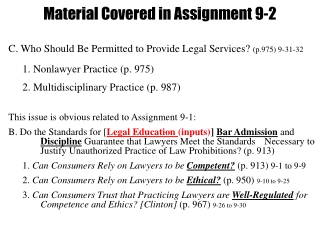
Material Covered in Assignment 9-2 C. Who Should Be Permitted to Provide Legal Services? (p.975) 9-31-32 1. Nonlawyer Practice (p. 975) 2. Multidisciplinary Practice (p. 987) This issue is obvious related to Assignment 9-1: B. Do the Standards for [Legal Education (inputs)] Bar Admissionand Discipline Guarantee that Lawyers Meet the Standards Necessary to Justify Unauthorized Practice of Law Prohibitions? (p. 913) 1. Can Consumers Rely on Lawyers to be Competent?(p. 913) 9-1 to 9-9 2. Can Consumers Rely on Lawyers to be Ethical?(p. 950) 9-10 to 9-25 3. Can Consumers Trust that Practicing Lawyers are Well-Regulated for Competence and Ethics? [Clinton] (p. 967) 9-26 to 9-30
Question 31 (p. 975) • 9-31. Who should provide legal services? • Only lawyers should provide legal services • Generally lawyers should provide legal services but independent paralegals should also be allowed to provide simple legal services. • Anyone should be able to provide legal services but only lawyers should be able to hold use the term "lawyers" to identify themselves. • Other/don’t know
Question 32 (p. 975) • 9-32. Should multidisciplinary practice be permitted? • Yes • No • Other/Don’t know • What about passive investment in law firms? • Yes • No • Other/Don’t know
Question 9-1 (p. 913) Law school training ensures that most lawyers are competent providers of legal services. Yes No Neither/unsure
Question 9-2 (p. 913) • People without law school training are unable to provide competent legal services. • Yes • No • Neither/unsure/it depends
Question 9-3 (p. 914) • Consumer protection requires that legal services providers graduate from law school. • Yes • No • Neither/unsure/it depends
Question 9-4 (p. 914) • The bar exam ensures that lawyers are competent to provide legal services. • Yes • No • Neither/unsure/it depends
Question 9-5 (p. 914) • People who have not passed the bar exam are unable to provide competent legal services. • Yes • No • Neither/unsure/it depends
Question 9-6 (p. 914) • Consumer protection requires that lawyers pass the bar exam. • Yes • No • Neither/unsure/it depends
Question 9-7 (p. 914) • The requirements of law school education and the bar exam together ensure that lawyers can provide competent legal • services. • Yes • No • Neither/unsure/it depends
Question 9-8 (p. 915) People who have not both graduated from law school and passed the bar exam cannot provide competent legal services.
Question 9-9 (p. 915) • Consumer protection requires that lawyers both graduate from law school and pass the bar exam. • Yes • No • Neither/unsure/it depends
Question 9-10 (p. 950) • A required law school professional responsibility course ensures that lawyers are ethical providers of legal services. • Yes • No • Neither/unsure/it depends
Question 9-11 (p. 950) • A required law school professional responsibility course ensures that lawyers are ethical providers of legal services. • Yes • No • Neither/unsure/it depends
Question 9-12 (p. 950) • Consumer protection requires that legal services providers pass a Professional Responsibility course. • Yes • No • Neither/unsure/it depends
Question 9-13 (p. 950) • The MPRE ensures that most lawyers are ethical providers of legal services. • Yes • No • Neither/unsure/it depends
Question 9-14 (p. 950) • People who have not passed the MPRE cannot ethically provide legal services. • Yes • No • Neither/unsure/it depends
Question 9-15 (p. 951) • Consumer protection requires that legal services providers pass the MPRE. • Yes • No • Neither/unsure/it depends
Question 9-16 (p. 951) • A law graduate who has failed to repay student loans should be admitted to the bar. • Yes • No • Neither/unsure/it depends
Question 9-17 (p. 951) • A law graduate with a prior conviction for selling marijuana should be admitted to practice law. • Yes • No • Neither/unsure/it depends
Question 9-18 (p. 951) • A law graduate who served a sentence for manslaughter before beginning law school should be admitted to the bar. • Yes • No • Neither/unsure/it depends
Question 9-19 (p. 951) • An adulterer should be admitted to the bar. • Yes • No • Neither/unsure/it depends
Question 9-20 (p. 952) • An alcoholic should be admitted to the bar. • Yes • No • Neither/unsure/it depends
Question 9-21 (p. 952) • A Nazi should be admitted to the bar. • Yes • No • Neither/unsure/it depends
Question 9-22 (p. 952) • The character and fitness requirement ensures that lawyers are ethical providers of legal services. • Yes • No • Neither/unsure/it depends
Question 9-23 (p. 952) • People who do not pass the character and fitness requirement are not ethical providers of legal services. • Yes • No • Neither/unsure/it depends
Question 9-24 (p. 952) • Consumer protection requires that legal services providers pass a character and fitness test. • Yes • No • Neither/unsure/it depends
Question 9-25 (p. 953) • Consumer protection requires that legal services providers pass a character and fitness test. • Yes • No • Neither/unsure/it depends
Question 9-26 (p. 967) • According to professionalism, lawyer discipline functions adequately only if lawyers snitch on each other. • Yes • No • Neither/unsure/it depends
Question 9-27 (p. 967) • The snitch rule works at law school because almost all students inform the law school administration when they believe that another student has cheated. • Yes • No • Neither/unsure/it depends
Question 9-28 (p. 967) • Lawyers reliably report disciplinary violations by other lawyers. • Yes • No • Neither/unsure/it depends
Question 9-29 (p. 968) • The Arkansas disciplinary regulators received a complaint that William Jefferson Clinton: 1) provided false, misleading, • and evasive deposition answers; 2) intentionally provided false testimony regarding sexual relations with Lewinsky; and 3) had • misled the American people in a televised address regarding plaintiff's lawyers' questions. If true, what sanction should • President Clinton have received? • Disbarment • Suspension • Censure • No punishment • There is no one correct response; any or none could be administered.
Question 9-30 (p. 968) • The disciplinary system protects consumers from legal services providers who are either incompetent or unethical. • Yes • No • Neither/unsure/it depends
Question 9-31 (p. 975) Who should provide legal services?
Question 9-32 (p. 975) Should multidisciplinary practice be permitted?
Question 9-33 (p. 1004) Should Pro Bono service be mandatory for law students?
Question 9-34 (p. 1004) Should Pro Bono service be mandatory for lawyers?
Question 9-35 (p. 1021) Legal practice is a: