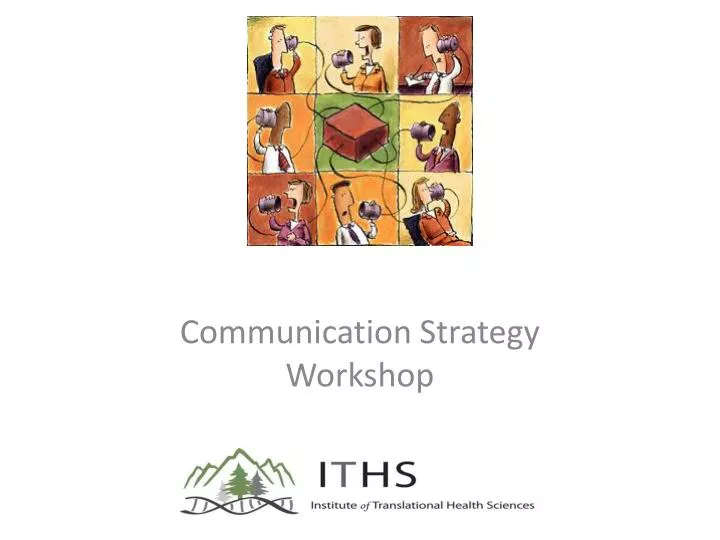

Communication Strategy Workshop
E N D
Presentation Transcript
Goals for the Day • Advance the communication strategies for individual research initiatives. • Identify overarching strategies that we might share or coordinate together. • Walk out of here with an action plan.
Post HeLa: People have questions • Who is using my data/specimens? • Who decides? • Who is making money? • What will happen? • Who is going to benefit from this? • How will I know? • Are we ready to answer them?
Why does communication matter? • Public dollars fund our research. We need to be accountable. We should build enthusiasm and support. • Transparency can promote trust. We need to be accountable. We do not want to surprise people.
Common Responses • Don’t Ask, Don’t Tell • We’ll have our message ready when they ask • It’s too complicated to explain • People aren’t interested • We should only put our best face forward
Public Opinion • 90% were concerned about privacy protections • 60% would participate in a biobank if asked • 48% would provide consent for all research if approved by an oversight board, 42% wanted to be asked for each 2008 public survey N= 4659 (58.4% response) Kaufman et al. 2009
Public Opinion • 72% wanted to know about research being done with anonymous samples; 81% with identifiable samples • 37% of reasons for wanting to know about what research was done were curiosity-based. • 57% would require researchers to seek permission, whereas 43% would be satisfied with notification only. • Phone interviews 2002 • 1,193 clinic patients • Hull et al. 2008
Re-Consent Prior to Data Sharing It is ethically necessary to obtain re-consent from research participants prior to sharing a de-identified sample or data with an investigator at another institution? % Don’t Know % Disagree % Agree PRIM&R 46 3 40 12 n=199 ASHG 43 44 3 10 n=346 Neutral Very/Somewhat Very/Somewhat DK Lemke et al, 2010; Trinidad et al, 2011
Beyond Broad Consent • How can we prepare someone to know how to respond when faced with a consent form? • Busy clinic • Stressful clinical context • Attention and priorites are elsewhere • The situation is prospective and dynamic “Some of my genetic information will be stored in some databases for some future uses.”
What Can Help? • Clear messaging – what are we doing and why • Community Advisory Boards – input throughout • Community Education – why this matters • Transparent Consent Process • Accountability for Data Use • Transparency of Partners and Agreements • Feedback loops built in – value is clear to all
Theme for the Day • Action-Oriented • Concrete • Path forward • We all have a part
The Projects’ “Brands” Washington PhenotypedBiospecimen Resource
What We Have in Common • Intent to “Do Good” • Pursuit of Generalizable Knowledge (Research) • Close Proximity to Clinical Care (Fiduciary Relationships) • Data and/or Specimens from Patients • Who May Not Understand Difference Between Care and Research
Where We Differ • Types of Patients • Recruitment/Consent • Locale • Timing relative to care • Types of Data • Clinical only • Specimens, prospective • Specimens, discarded • Data Retention and Sharing • Individual Investigators • Repositories • Academic • Industry