Enhanced At-Home Rehabilitation Device for Post-ACL Repair Using EMG Feedback
Our innovative rehabilitation device, a recumbent stationary bicycle, utilizes electromyography (EMG) technology to monitor the quadriceps muscles during rehabilitation. Designed specifically for patients recovering from ACL repair, this user-friendly interface aids in autonomous recovery by providing real-time feedback on muscle activity. The device supports phases II and III of rehabilitation, ensuring that users can perform at-home exercises correctly and effectively. With future enhancements planned for signal processing and graphical user interface, we aim to optimize patient recovery and engagement.
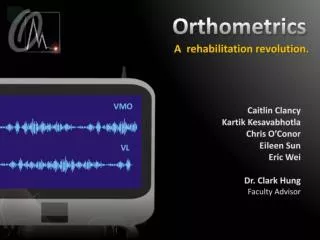

Enhanced At-Home Rehabilitation Device for Post-ACL Repair Using EMG Feedback
E N D
Presentation Transcript
Project Overview • Our product: • Rehabilitation device Recumbent stationary bicycle • Electromyography of quadriceps muscles Feedback • User-friendly interface Autonomous recovery • Our customers: • Post-ACL repair patients • Phase II and III of rehabilitation • Assist in at-home exercises Overview|Relevance | Design Goals | Signal Acquisition | Signal Processing | Future Work
Clinical Relevance 1) EMG signals differ between patellofemoral pain syndrome patients and control Cowan SM, et al. Arch Phys Med Rehabil. (2001) 82:183-189. 2) Literature on EMG acquisition on bicycles Garrett WE, Kirkendall DT. Exercise and Sport Science. Lippincott Williams & Wilkins. (2000) 3) Quadricep EMG signals differ between ACL patients and control when cycling Hunt MA, et al. Clinical Biomechanics. (2003) 18: 393-400. Overview|Relevance | Design Goals | Signal Acquisition | Signal Processing | Future Work
Clinical Relevance 1) EMG signals differ between patellofemoral pain syndrome patients and control Cowan SM, et al. Arch Phys Med Rehabil. (2001) 82:183-189. 2) Literature on EMG acquisition on bicycles Garrett WE, Kirkendall DT. Exercise and Sport Science. Lippincott Williams & Wilkins. (2000) 3) Quadricep EMG signals differ between ACL patients and control when cycling Hunt MA, et al. Clinical Biomechanics. (2003) 18: 393-400. Overview|Relevance | Design Goals | Signal Acquisition | Signal Processing | Future Work
Clinical Relevance 1) EMG signals differ between patellofemoral pain syndrome patients and control Cowan SM, et al. Arch Phys Med Rehabil. (2001) 82:183-189. 2) Literature on EMG acquisition on bicycles Garrett WE, Kirkendall DT. Exercise and Sport Science. Lippincott Williams & Wilkins. (2000) 3) Quadricep EMG signals differ between ACL patients and control when cycling Hunt MA, et al. Clinical Biomechanics. (2003) 18: 393-400. Overview|Relevance | Design Goals | Signal Acquisition | Signal Processing | Future Work
Design Goals • Signal Acquisition • Collect EMG data while cycling • Correlate crank angle with EMG signal • Signal Processing • Filtering noise • Algorithms to analyze signal • Developing user-friendly interface • Testing • Protocol optimization • Proof of concept Overview|Relevance | Design Goals | Signal Acquisition | Signal Processing | Future Work
Components and Setup Overview |Relevance | Design Goals | Signal Acquisition | Signal Processing | Future Work
EMG Electrode Placement Electrode placement on the quadriceps muscles Cowan SM, et al. Arch Phys Med Rehabil. (2001) 82:183-189. Overview |Relevance | Design Goals | Signal Acquisition | Signal Processing | Future Work
180o 270o 90o 0o Magnets Hall Effect Sensor Overview|Relevance | Design Goals | Signal Acquisition | Signal Processing | Future Work
EMG Acquisition VMO, ~50 rpm, Hall effect sensor at 180o Voltage (volts) Time (ms) Overview |Relevance | Design Goals | Signal Acquisition | Signal Processing | Future Work
EMG Acquisition VMO, ~40 rpm, Hall effect sensor at 0oand 180o Voltage (volts) Time (ms) Overview |Relevance | Design Goals | Signal Acquisition | Signal Processing | Future Work
The Butterworth Filter Overview|Relevance | Design Goals | Signal Acquisition | Signal Processing | Future Work
Unfiltered Data Overview|Relevance | Design Goals | Signal Acquisition | Signal Processing | Future Work
Filtered Data Cowan SM, et al. Arch Phys Med Rehabil. (2001) 82:183-189. Overview|Relevance | Design Goals | Signal Acquisition | Signal Processing | Future Work
Garrett WE, Kirkendall DT. Exercise and Sport Science. Lippincott Williams & Wilkins. (2000) Integrated Data Overview|Relevance | Design Goals | Signal Acquisition | Signal Processing | Future Work
Experiments Overview|Relevance | Design Goals | Signal Acquisition | Signal Processing | Future Work
Future Work • Develop a user-friendly GUI • Correlate position with crank angle more precisely • More signal processing for de-noising • Process the signal and plot as a function of crank angle or time • Proof of concept studies with current recovering ACL patients Overview|Relevance | Design Goals | Signal Acquisition | Signal Processing | Future Work
Bloopers Overview |Relevance | Design Goals | Signal Acquisition | Signal Processing | Future Work
Acknowledgements Dr. William Macaulay Orthopedic Surgeon, Columbia University Medical Center Director of Center for Hip and Knee Replacement Dr. Ranjan Gupta Department Chair of Orthopaedic Surgery, UC Irvine Professor of Orthopaedics, Anatomy & Neurobiology, and BME James Gossett Associate Athletic Director, Columbia University Dr. Evan Johnson Director of Physical Therapy at the Spine Center Administrative Director of the Spine Center Julianne Costa Occupational Therapist Registered Physical Therapist Dr. Tim Wright Orthopaedic Biomechanics and Biomaterials Hospital of Special Surgery Dr. Clark Hung Associate Professor of Biomedical Engineering Dr. Gordana Vunjak-Novakovic Professor of Biomedical Engineering Dr. Paul Sajda Associate Professor of Biomedical Engineering Dr. Elizabeth Hillman Assistant Professor of Biomedical Engineering Keith Yeager Senior Staff Associate, Laboratory Manager Sean Burgess Teaching Assistant Robert MaidhofTeaching Assistant Viktor Gamarnik BME Senior, SMArtView Overview |Relevance | Design Goals | Signal Acquisition | Signal Processing | Future Work