Nutrients
Nutrients . Chemicals of Living Things. Biological Macromolecules. Living things are composed of nonliving materials (molecules and ions) Some molecules and ions are simple (water, phosphates, hydrogen ions, sodium ions, calcium ions, etc). They are inorganic matter.

Nutrients
E N D
Presentation Transcript
Nutrients Chemicals of Living Things
Biological Macromolecules • Living things are composed of nonliving materials (molecules and ions) • Some molecules and ions are simple (water, phosphates, hydrogen ions, sodium ions, calcium ions, etc). They are inorganic matter. • Other molecules contain carbon bonded to hydrogen and other atoms such as oxygen, sulfur, and nitrogen. They are called organic molecules • Larger and more complex organic molecules are called macromolecules
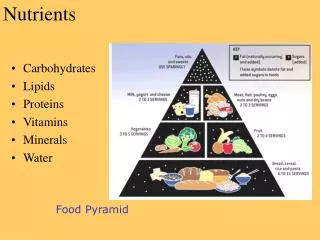
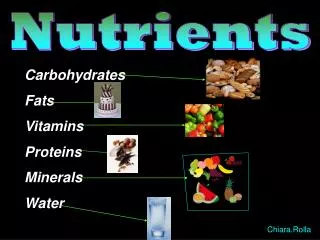
Macromolecules and Nutrients • Macromolecules are known as nutrients (raw materials that our body needs to obtain energy for survival) • Energy released from these macromolecules is used to maintain the body's metabolism – all the chemical processes carried out by cells to maintain life • Biological macromolecules include: - Carbohydrates - Proteins - Lipids - Nucleic acids
Monomers and Polymers • Cells are able to make macromolecules by joining smaller subunit molecules together into chains known as polymers. • Polymers – large molecules consisting of identical or similar building-block molecules in a chain. • Monomers – the individual building-block molecules in a polymer
Carbohydrates • The most important source of energy • Make up the largest component in most diets • Provide short-term energy to cells (energy that can be quickly utilized) • Structurally, consist of C, H, and O • Human body cannot make these important chemicals by itself (relies on plants as the source of carbohydrates)
Classification of Carbohydrates • Monosaccharides – simple sugars made up of a single sugar molecule (or monomer) • Examples of monosaccharides: Glucose (C6H12O6) is found in all cells of our body and is the primary source of energy Fructose – a simple sugar found in fruits Galactose – one of the sugars found in milk
Disaccharides • Sugars that consist of two monosaccharides • Formed by condensation reactions • Examples of disaccharides include: • Maltose – made from two glucose molecules. • Sucrose (or table sugar) – made from a combination of a glucose and a fructose molecule • Lactose (found in milk) is composed of glucose and galactose.
Polysaccharides • Complex carbohydrates (large molecules) • Polymers of monosaccharides such as glucose • Some important polysaccharides include: • Starch – the energy storage molecule in plants and a good source of energy for human cells • Glycogen – the short-term energy storage molecule in human cells • Cellulose – the molecule that makes up plant cell walls; humans and others animals cannot break it down into glucose
Lipids • Organic compounds that include fats, phospholipids, and steroids • Supply energy to the cells of the body • Unlike carbohydrates, lipids are not broken down easily by our body • Excellent energy storage compound • Insoluble in water; they are only soluble in substances such as acetone, alcohol, etc.
Fats • Consist of two structural units: one glycerol molecule and three fatty acids • Fatty acids – long C-H chains with a carboxyl group COOH at one end • Saturated fatty acids – contain the maximum number of H atoms possible; no double bonds between C atoms (e.g. animal fats) • Unsaturated fatty acids- have one or more double bonds between C atoms (plant fats)
Other Lipids • Phospholipids - the main components of cell membranes; composed of a phosphate group (soluble in water) and two fatty acids molecule (insoluble in water) attached to the glycerol backbone • Steroids – consist of 4 linked C rings; include cholesterol and certain sex hormones • Cholesterol is used by our body to make certain hormones; it is also an important part of the cell membrane. Two much of cholesterol can cause heart and/or arterial disease
Proteins • Proteins direct and control the chemical reactions in life processes (part of the cell membrane; provide support and shape to cells; enzymes) • Proteins are composed of 20 different amino acid building blocks; a chain of amino acids can be referred to as a polypeptide • Essential amino acids – there are 8 amino acids that the body cannot synthesize; they must be obtained from food
Nucleic Acid • Two types of nucleic acids: DNA (deoxyribonucleic acid) and RNA (ribonucleic acid) • They are not nutrients but they are essential for all living things – they direct growth and development of all organisms using a chemical code • The sequence of amino acids in a protein molecule is determined by the sequence of nucleotide bases in a segment of DNA called a gene
Enzymes • Macromolecules must be chemically broken down into small molecules before the body can use them • Only small molecules can be absorbed by the cells lining the small intestine • The breakdown of the chemical bonds between macromolecules involves enzymes • Enzymes are a special class of protein molecules that act as catalysts
MicronutrientsVitamins and Minerals • Important in maintaining the overall metabolism of the body • Needed on a daily basis to sustain life and maintain health • Taken in extremely small quantities • Cannot be used as an energy source
Vitamins • Organic compounds – contain C, H, O, N, and small amounts of other elements • Most of them act as coenzymes (joining to specific enzymes) • Two major groups: • Fat-soluble • Water-soluble
Fat-soluble Vitamins • Vitamins A, D, E, and K • Found in the fats and oils that we eat (that’s why a certain amount of fat intake is part of a healthy diet) • Cannot be excreted; they break down over time as they participate in metabolic processes
Water-soluble Vitamins • Include vitamins B and C • Eliminated from the body relatively quickly (that’s why a daily intake is recommended) • When too much of B and C vitamins is taken, the excess is excreted in the urine
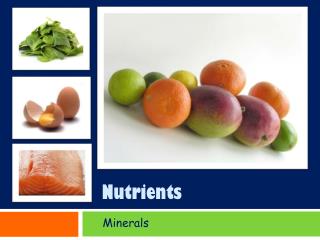
Minerals • Inorganic compounds required by the body • Found in some of the most important molecules in the body Examples: • Hemoglobin-the protein in the red blood cells has 4 iron atoms • Calcium is a major component for healthy teeth and bones The body doesn’t destroy the minerals but loses them in sweat and urine; it is important to replenish them through a balanced diet - fruits, whole grains, meats, and vegetables.