
SlideServe
Menu
Preferences
© SlideServe · v2026

Surface Modification of Polyisobutylene-based Biomaterials for Enhanced Functionality

levi avatar
2 slides · 241 Views · 30 likes · Sep 04, 2014

This research project, led by Judit E. Puskas at the University of Akron, focuses on synthesizing functionalized polymers and block copolymers using Candida Antarctica Lipase B (CALB) for transesterification and Michael addition reactions. The study includes the development of PIB-PEG and PIB-TEG materials and the investigation of protein adsorption on electrospun fibers, collaborating with multiple professors. The work also emphasizes outreach initiatives in STEM education, involving undergraduate and high school students, fostering collaboration between science and art.
Surface Modification of Polyisobutylene-based Biomaterials for Enhanced Functionality - slide 1
01 / 2Surface Modification of Polyisobutylene-based Biomaterials for Enhanced Functionality
1 / 17

Download Presentation

Surface Modification of Polyisobutylene-based Biomaterials for Enhanced Functionality
An Image/Link below is provided (as is) to download presentation

Download Policy: Content on the Website is provided to you AS IS for your information and personal use and may not be sold / licensed / shared on other websites without getting consent from its author.Content is provided to you AS IS for your information and personal use only. Download presentation by click this link. While downloading, if for some reason you are not able to download a presentation, the publisher may have deleted the file from their server.During download, if you can't get a presentation, the file might be deleted by the publisher.

E N D

More Related Content

Presentation Transcript
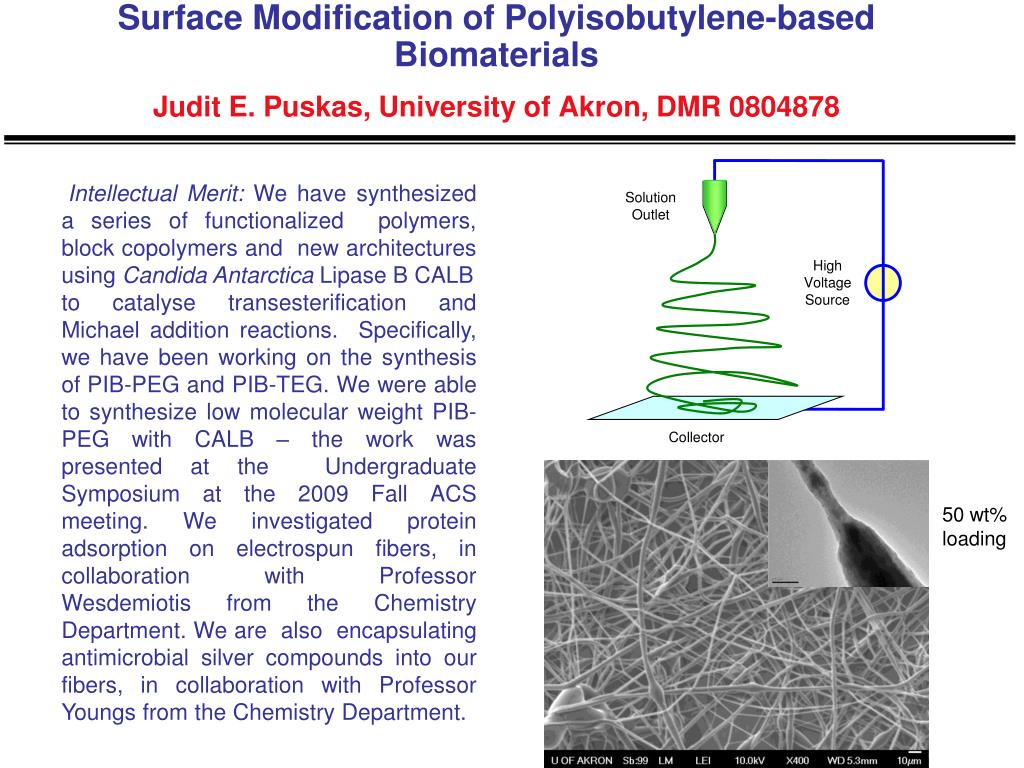
  1. Surface Modification of Polyisobutylene-based BiomaterialsJudit E. Puskas, University of Akron, DMR 0804878 Intellectual Merit: We have synthesized a series of functionalized polymers, block copolymers and new architectures using Candida Antarctica Lipase B CALB to catalyse transesterification and Michael addition reactions. Specifically, we have been working on the synthesis of PIB-PEG and PIB-TEG. We were able to synthesize low molecular weight PIB-PEG with CALB – the work was presented at the Undergraduate Symposium at the 2009 Fall ACS meeting. We investigated protein adsorption on electrospun fibers, in collaboration with Professor Wesdemiotis from the Chemistry Department. We are also encapsulating antimicrobial silver compounds into our fibers, in collaboration with Professor Youngs from the Chemistry Department. Solution Outlet High Voltage Source Collector 50 wt% loading

  2. Surface Modification of Polyisobutylene-based BiomaterialsJudit E. Puskas, University of Akron, DMR 0804878 Broader Impacts: Notable outreach initiative was made over the past year to expose undergraduates, and high school students and teachers to STEM2 education. Ms. S.E. Porosky participated in this project as part of the NSF Research Experience for Undergraduates (REU) last summer. This summer we had Ms. Porosky as well as Ms. K. Neyman from the Departmental REU program, Mr. J. Friess and Mr. E. Elmond (High school students) and Mr. D. Chapman (RET) as outreach members this summer. More than 100 people attended the lecture by Gerald H. Pollack as part of the Synapse series, fostering enlightened collaborations between art and science. This lecture was made possible through the current grant in a framework of a new program connecting science and art, to broaden the horizon for students of both disciplines. Mr. Friess at work on a thermal analysis device Mr. Chapman developing a new implant prototype Web site: http://gozips.uakron.edu/~jpuskas/