Quantum Theory
This overview delves into quantum theory, focusing on key concepts such as blackbody radiation, Planck's constant, and the behavior of light. It explains how blackbodies absorb and emit light, the significance of spectra and discrete energy levels, and the empirical equations that model observed phenomena. We highlight Max Planck's contributions, including his postulate that defines the relationship between energy and light frequency. This resource is essential for grasping the foundational elements of quantum mechanics and the nature of light.

Quantum Theory
E N D
Presentation Transcript
Quantum Theory By: Lucas, Steven, Brandon and Kristen
Vocabulary • Spectra: the range of colors that a object will give off when it is heated or burned. • Blackbody: An object that will absorb all light and can radiate it will almost no gaps in its spectrum. • Discrete: Apart from, or separate from others of its kind.
Vocab cont… • Quantum: a discrete amount of energy, given by the product of Planck's constant(h) and the frequency of the radiation (f) • Empirical equation: an equation that fits the observed data but is not based on any theory • Postulate: a claim, something said without proof of consept.
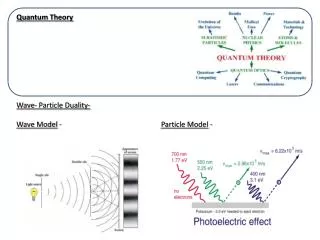
Properties of light • The color of light is determined by the its wavelength. • Increasing or decreasing the temperature of an object will change the color of the light it emits. • Each color of light can only have a a set number of different energy levels.
Blackbody radiation • When a blackbody is heated it follows a color path until it reaches a certain temperature limit. • The pattern stops once you reach the ultraviolet end of the spectrum.
Max Planck • A German physicist that is credited with creating the founding for quantum theory. • He won the Nobel Prize in 1918 for his work in quantum mechanics. • Now he is known for: 1. Planck’s postulate 2. Planck’s constant 3. Planck's law of black body radiation
Planck’s constant and postulate • He used pervious theory about blackbody radiation and experiments done with the blackbody radiation spectrum to derive this constant. • H= 6.626 068 96 x 10^(-34) j*s • His postulate Allows use to find the energy of light at any frequency • E=nhv • n is a discrete value that depends on the color of light you are dealing with, h is Planck's constant and v is the frequency.