Problem-Solving Practice
This exploration into decision-making reveals common cognitive traps, such as confirmation bias and overconfidence, that hinder effective thinking. It delves into heuristics like the representative, availability, and anchoring heuristics, showcasing how these can distort our understanding of situations. Through practical examples, such as the impact of framing on choices, the content illustrates techniques to improve creativity and problem-solving abilities in any field. By understanding these psychological influences, we can make more informed, rational decisions and elevate our decision-making skills overall.

Problem-Solving Practice
E N D
Presentation Transcript
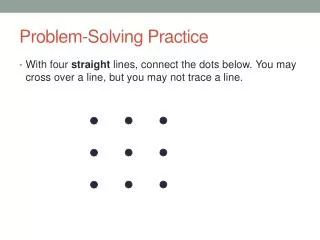
Problem-Solving Practice • With four straight lines, connect the dots below. You may cross over a line, but you may not trace a line.
Creativity • Definition: the capacity to use information and/or abilities in original ways. • You can be creative in any field of study (math, science, history, etc.
Poor Decision-making Practices • Confirmationbias: we tend to seek out information that agree with our preconceptions. • Lazy man believes that the key to stop smoking is using a nicotine patch (and never considers behaviorist therapies) • How Americans get their political news today: we follow the liberal/ conservative news outlets that reflect our personal political ideologies
Problems with Heuristics • Recall what a heuristic is. • RepresentativeHeuristic: If an item is similar to members of a concept, we assume it is also a member of that concept • We flip a coin 5 times and it comes up heads every time. We assume it will come up heads again (its still a 50/50 chance each time)
Problems with Heuristics • AvailabilityHeuristic: relying on information that is either more accessible and overlook information that is less prominent • “Murder is on the rise!” (because you watch too much local news. Murder rates are dropping in most cities) • AnchoringHeuristic: we make our decisions/form judgments based on ideas/standards that are important to us • Having continuous access to the internet is important to you, therefore you make the poor economic decision to pay for your $30 a month data plan (that you don’t even use half of most months).
Overconfidence • Overconfidence: we overestimate the accuracy of what we know. • Confirms beliefs we already hold • Explaining away failure (someone else’s fault) • Overconfidence can make you happier, if more incorrect. • Overconfidence can explain why people accomplish less in their lives than they hope • “Picking up guitar will be easy!”
Framing • Framing: the way an issue/information is presented • Can enormously impact how people form their decisions • Would you rather buy 5 cans for $4 or each can for 79 cents? • Students who are presented with regular milk in front of chocolate milk tend to pick the healthier regular milk more than if the two options are presented side by side. • Fresh veggies and fruits displayed at eye level in a cafeteria line fly off the shelf. • The book Nudge does a fantastic job of applying this principle in a variety of settings, from picking health insurance to eating more vegetables to reforming Social Security and the tax code.