DNA Profiling Techniques Using PCR: An Overview of STR Analysis and Applications
This article explores the process of DNA profiling through the analysis of Short Tandem Repeats (STRs), also known as microsatellites. STRs are non-coding DNA sequences consisting of short, repeating units. The DNA profiling process involves obtaining a DNA sample, amplifying specific STR regions using Polymerase Chain Reaction (PCR), and separating the amplified fragments through gel electrophoresis. STR analysis is crucial in criminal investigations for matching suspect DNA with crime scene samples, along with various applications in paternity testing and genetic screening.

DNA Profiling Techniques Using PCR: An Overview of STR Analysis and Applications
E N D
Presentation Transcript
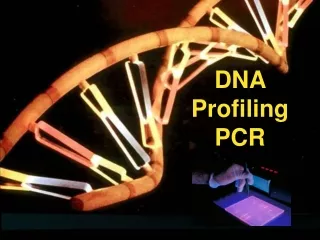
DNA Profiling Using PCR Sara Small, Sarah Petroni, AnneliseYackow
Short Tandem Repeats (STRs) • Also known as microsatellites. • Short, repeating pieces of 2-6 base pairs. • They are non-coding and scattered throughout the genome. • Each individual has a varying number of repeated STRs. Each STR can be repeated up to 100 times.
Process of DNA Profiling 1. Obtain a DNA sample: • Collect tissue from a living or dead organism. • This tissue is then treated with chemicals and enzymes to extract the DNA from the sample. • Only a minimal amount of DNA is necessary.
Process of DNA Profiling 2. Amplify the STR regions using PCR: • Specific primers attach to each end of the STRs. These primers make large quantities of each region. • No other part of the DNA is amplified or replicated. • This process only takes around five minutes.
Process of DNA Profiling 3. Gel Electrophoresis: This process separates the fragments by length. The smaller fragments travel faster than the longer fragments. At this point in the process, it is easy to calculate the length of each STR region and the number of repeat STRs at each site. From here, one can analyze the results of DNA electrophoresis. Lanes with many regular bands are used for calibration, determining the length of fragments in unknown samples.
Use in Criminal Investigations • In criminal investigations, thirteen STR regions are analyzed. To be convicted, a criminal’s DNA must match the crime scene DNA at all thirteen regions. • The odds of another person sharing the same result are about one in a billion.
Other Uses of DNA Profiling • Genetic relatedness such as paternity testing, checking animal pedigrees, or searching for a specific gene in disease screening.