Understanding DNA Profiling: Applications and Techniques in Forensic Science
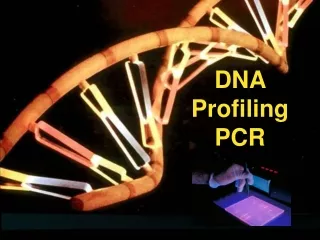
DNA profiling, previously known as DNA fingerprinting, is the process of determining an individual's DNA profile from biological samples. It plays a crucial role in forensic science for identifying crime scene fluids, confirming familial relationships in breeding programs, and identifying disaster victims, like those affected by the Boxing Day tsunami. This technique involves extracting DNA from samples, amplifying it using PCR, and analyzing specific short tandem repeats (STRs) to create unique profiles. The advances in DNA technology have significantly improved its accuracy and reliability in various applications.

Understanding DNA Profiling: Applications and Techniques in Forensic Science
E N D
Presentation Transcript
DNA Profiling Used to be called DNAfingerprinting, but this was confusing http://www.5min.com/Video/DNA-Genetic-Fingerprinting-1354231 (genetic fingerprinting, 2 min)
DNA profiling is the process where a specific DNA pattern, called a profile, is obtained from an individual or tissue sample ?
Uses of DNA Profiling: To identify the probable origin of a body fluid sample associated with a crime or crime scene.
Uses of DNA Profiling: To reveal family relationships e.g. checking on pedigree in stock breeding programs. e.g. checking that captive populations of endangered species are not inbred.
Uses of DNA Profiling: To identify disaster victims. For example, ESR scientists traveled to Thailand to help identify victims of the Boxing Day tsunami
Uses of DNA Profiling: Genetic screening: the presence of a particular gene, such as cystic fibrosis) in a family.
Polymorphisms (differences) Most of our DNA is identical to other people’s DNA Alleles usually differ by only a base or two Non-coding regions vary greatly between people Differences called polymorphisms. Unique combination of polymorphisms Unique DNA profile
Short Tandem Repeats (STRs) Eg CATG ATCATGGATCATGCATGCATGCATGCATGCATGTTCCATGATA Found at specific loci Number of repeats varies greatly Homologous chromosomes have different numbers of repeats.
Profile is unique DNA profile - ten specific STRs No two people (except identical twins) are likely to have the same numbers of repeats in all of these STRs.
Microsatellite containing 4 repeat units Homologous pair of chromosomes telomeres centromeres Microsatellite containing 7 repeat units Flanking regions to which PCR primers can be attached
1 Get a sample DNA found in most cells (eg white blood cells, semen, hair roots) and body fluids, such as saliva and perspiration. Forensic scientists and police officers collect samples of DNA from crime scenes.
2. Extract the DNA DNA is contained within the nucleus of cells. Chemicals are added to break open the cells, extract the DNA, and isolate it from other cell components.
Magnify the DNA PCR used to magnify the DNA sample for profiling. Specific primers are used during PCR, which attach a fluorescent tag to the copied STRs.
4. Determine the size of the STRs Gel electrophoresis separates the STRs and can detect the fluorescent dye on each STR. More repeats Larger STRs
Useful links for DNA profiling DNA profiling at ESRESR is a Crown Research Institute and is New Zealand’s leading organization working in forensic science. www.esr.cri.nz/competencies/forensicscience/dna/Pages/currenttechniques.aspx Forensic success storiesNew Zealand examples of DNA profiling helping to solve real crimes. www.esr.cri.nz/competencies/forensicscience/Pages/ForensicSuccessStories.aspx DNA profiling to test for parentageA presentation on DNA profiling made by a New Zealand High school teacher. Please click on ‘DNA profiling’ to access. www.sbs.auckland.ac.nz/uoa/science/about/departments/sbs/student_information/....cfm DNA profiling interactiveA student-friendly interactive demonstration developed by Biotechnology Online Australia. Try using DNA profiling to investigate a crime or work out who is entitled to inheritance. www.biotechnologyonline.gov.au/biotechnologyonline/popups/int_dnaprofiling.html Human identification made simpleA student-friendly description of DNA profiling and how it is used in a variety of international court cases. Go to ‘human identification’ to access. www.dnai.org/d/index.html http://www.5min.com/Video/Restriction-Fragment-Length-Polymorphisms-Genetic-Markers-151426148 (Wolfe, genetic markers, 11 min) http://www.5min.com/Video/Genetic-Screening-151018455 (Wolfe, screening, 11 min)