Download
1 / 10
0 likes | 0 Views
Industrial valves are essential mechanical devices used to control, regulate, or direct the flow of fluids such as liquids, gases, and slurries within industrial systems. They play a critical role in industries like oil and gas, power generation, water treatment, chemical processing, and manufacturing. Depending on the application, different types of valvesu2014such as gate, globe, ball, butterfly, and check valvesu2014are used to ensure safety, efficiency, and precise flow control.

E N D
Industrial Valves: Types and Applications A comprehensive guide to understanding valve systems, their functions, and critical applications across industries
FUNDAMENTALS What Are Industrial Valves? Industrial valves are sophisticated mechanical devices designed to control the flow and pressure of liquids, gases, and slurries within complex piping systems. They serve as the critical control points for starting, stopping, throttling, redirecting, and protecting fluid flow throughout industrial operations. From oil refineries to water treatment facilities, valves form the backbone of safe and efficient fluid management across diverse sectors including oil & gas, power generation, chemical processing, and food & beverage manufacturing.
Core Functions of Valve Systems On/Off Control Flow Regulation Directional Control Overpressure Protection Complete flow isolation by fully starting or stopping fluid movement through the system Precise throttling and adjustment of flow rates to maintain optimal system performance One-way flow management preventing backflow and protecting critical equipment Automatic pressure relief to prevent catastrophic system damage and ensure safety Together, these functions create comprehensive system balancing and operational safety across industrial applications.
ISOLATION VALVE Gate Valves: The Classic Isolation Solution How It Works Advantages Gate valves operate by lifting a wedge- shaped gate perpendicular to the flow path, creating an unobstructed passage when fully open. This design makes them ideal for applications requiring complete flow isolation rather than throttling control. Minimal pressure drop when fully open Unobstructed flow path for efficient operation Cost-effective for large diameter applications Excellent sealing in closed position Limitations Key Applications Slow opening/closing operation Potential for seat leakage under thermal cycling Not suitable for throttling applications High-pressure steam systems Water distribution networks Fuel transmission lines High-temperature industrial processes
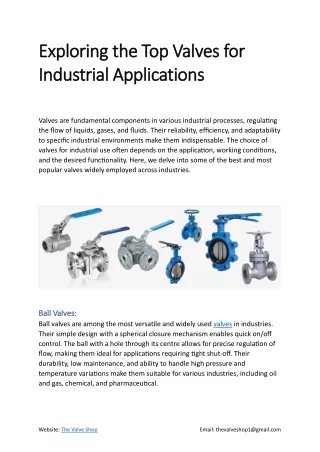
QUICK ACTION Ball Valves: Rapid and Reliable Shutoff Ball valves utilize a hollow, rotating spherical element with a cylindrical bore to control flow. A simple 90-degree turn of the handle provides instant start or stop capability, making them one of the fastest- acting valve types available. Their tight sealing characteristics and bubble-tight shutoff make them exceptionally reliable for both gas and liquid applications across a wide range of operating conditions. 0.5-30 700 200°C Size Range Pressure Rating Temperature Centimeters in diameter Bar maximum capacity Operating capability Common Variants & Applications Floating Ball Standard design for low to medium pressure applications in chemical plants and refineries Trunnion-Mounted Heavy-duty configuration for high-pressure systems and large diameter pipelines Full & Reduced Bore Flow optimization options for different velocity and pressure drop requirements
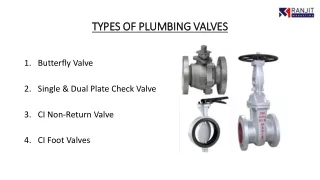
Butterfly Valves: Efficient Lightweight Control Design & Operation Primary Applications Butterfly valves feature a circular disc mounted on a rotating shaft at the center of the flow path. With a quarter-turn rotation, the disc swings from fully closed to fully open, providing quick operation in a remarkably compact package. Their lightweight construction and minimal space requirements make them particularly advantageous for large diameter piping systems where traditional gate valves would be prohibitively heavy and expensive. Municipal water supply systems Wastewater treatment plants Fire protection networks Gas distribution infrastructure HVAC systems Advantages Simple maintenance, minimal components, space-efficient design, cost-effective for large sizes Limitations Limited throttling precision, disc remains in flow path, not optimal for high pressure drops
PRECISION CONTROL Globe Valves: Mastering Flow Regulation Globe valves employ a movable plug that raises or lowers against a stationary ring seat, creating linear flow control with exceptional precision. The unique Z-shaped flow path through the valve body allows for fine throttling adjustments unavailable in simpler valve designs. Why Choose Globe Valves? Superior Leak-Tightness Metal-to-metal or soft seat design ensures bubble-tight shutoff Precise Throttling Linear motion enables accurate flow rate adjustment Frequent Operation Designed for repeated cycling without performance degradation Critical Applications Globe valves excel in chemical feed systems requiring precise dosing, cooling water circuits demanding accurate temperature control, and steam lines where throttling and tight shutoff are both essential. While they create higher pressure drops due to directional flow changes, this tradeoff is worthwhile when precision control is paramount.
Check Valves: Automatic Backflow Prevention Forward Flow Valve opens with system flow Flow Reversal Reverse pressure triggers closure Equipment Protected No manual action required Check valves provide essential protection by automatically preventing reverse flow without manual intervention or external control systems. Common Types Key Applications Pump discharge protection Water treatment systems Oil & gas pipelines Boiler feedwater lines Swing Check Hinged disc swings open with flow, suitable for horizontal lines with steady flow Lift Check Vertical disc lifts with pressure, ideal for high- pressure applications and steam service Not recommended for rapid cycling systems due to potential water hammer and vibration issues
Specialized Valve Types for Unique Needs Drum Gate Valves Needle Valves Control Valves Safety & Relief Valves Specialized valves mounted on drums and storage tanks for safe, controlled liquid dispensing with spill prevention Ultra-precise flow control through tapered needle point in small-bore systems and instrumentation lines Automated throttling valves with actuators for continuous process regulation and system optimization Spring-loaded protection devices that automatically open during overpressure events to prevent catastrophic failures
Choosing the Right Valve for Your System 1 2 Assess Requirements Analyze flow characteristics, pressure ratings, temperature ranges, and safety needs of your specific system Match Function Select valve type based on primary function: isolation, throttling, directional control, or overpressure protection 3 4 Specify Details Consider materials of construction, size requirements, and actuation method (manual, pneumatic, or electric) Ensure Success Proper selection guarantees operational efficiency, system safety, and long-term equipment longevity Ready to optimize your valve selection? Understanding the unique strengths and limitations of each valve type empowers you to make informed decisions that enhance system performance and reliability. Let's explore how the right valve solution can transform your industrial operations.