Download
1 / 25
250 likes | 353 Views
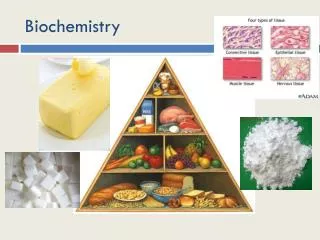
Biochemistry explores the chemical composition of living organisms, focusing on compounds essential for life. The four primary elements—carbon, nitrogen, oxygen, and hydrogen—comprise about 96% of the human body. Living things are composed of inorganic compounds (like water and minerals) and organic compounds, primarily carbon-based molecules like carbohydrates, proteins, and lipids. Through processes like polymerization, dehydration synthesis, and hydrolysis, these compounds interact to store or release energy, supporting life functions. Key functional groups such as hydroxyl and carboxyl are crucial in forming diverse biomolecules.

E N D
bIOCHEMISTRY The Chemical Composition of Living Things
COMPOUNDS in LIVING THINGS • Four main elements that make up 96% of the human body: • Carbon • Nitrogen • Oxygen • Hydrogen • Inorganic Cmpds: • Do NOT contain C • Exception to rule • CO2 • Examples: • Water • Minerals • Metals • Sand • Rock
ORGANIC COMPOUNDS • Carbon molecules • Importance of Carbon • Forms 4 strong stable covalent bonds • Form single, double & triple bonds • Examples: • Carbohydrates • Fats • Proteins • Polymerization – building of complex molecules • Monomer • Single unit • Polymer • Multiple repeating units • Macromolecule • Large chain of compounds
POLYMERIZATION • Dehydration Synthesis • Dehydration • Loss of water • Synthesis • Creation • Build organic molecules • Create bonds = store energy • Humans – protein production • Plants – fruit & veggie production • Hydrolysis • Hydro – water • Lysis – splitting • Break organic molecules apart • Break bonds = release energy • Digestion – release energy from food
ORGANIC MOLECULES • Molecular Formula • # elements in a compound • Example: • H2O • CH4 • C6H12O6 • Structural Formula • Picture of compound • Shows arrangement & bond type • Example: H H C H H
ORGANIC MOLECULES • Must contain Carbon • Hydrocarbon: • Simplest organic • Chains of carbon connected by single, double or triple bonds • Remaining bonds are filled with hydrogen • Ex: _________ C CCC • Ex: _________ C CCC • Ex: _________ C CCC
FUNCTIONAL GROUPS • Hydroxyl: • Also called Alcohols • Abbreviated: • Ex: Ethanol
FUNCTIONAL GROUPS • Carboxyl: • Create acids • Abbreviated: • Ex: acetic acid
FUNCTIONAL GROUPS • Carbonyl: • Given different names based on location w/in molecule • Aldehyde – end • Ketone – middle • Ex: Formaldehyde
FUNCTIONAL GROUPS • Amine: • Create bases • Abbreviated: • Examples:
FUNCTIONAL GROUPS • Identifying Organics • Is Carbon present? • Yes – Organic • No - Inorganic • Is Nitrogen present? • Yes – Protein • No – Carb or Lipid • Is there a 2:1 ratio of Hydrogen to Oxygen • Yes – Carb • No - Lipid
CARBOHYDRATESSugars & Starches • Monosaccharides • Simple sugars • Building blocks of carbs • Examples • Glucose – C6H1206 • Galactose – C6H1206 • Fructose - C6H1206 • Disaccharides • Double sugars • Created thru dehydration synthesis • Examples • Sucrose – C12H22011 • Maltose – C12H22011 • Lactose - C12H22011
CARBOHYDRATESSugars & Starches • Polysaccharides • Very long chains of monosaccharides • Examples: • Starch • Cellulose (fiber) • Glycogen • Chitin • Functions: • Energy • Simple – instant • Complex – longer lasting • Stored energy • Plants cellulose • Animals glycogen (liver) • Structural Support • Cellulose stems & leaves • Chitin insect exoskeletons
MONOSACCHARIDES Glucose Fructose
POLYSACCHARIDES Alpha – glucose (Starch) Beta-glucose (Cellulose)
LIPIDSFats, Oils & Waxes • Building Blocks • Glycerol • 3 Fatty Acids
LIPIDS • Functions: • Long term energy • Hibernation • Protection • Internal organs • Insulation • Functions: • Cell membranes • Chemical Messengers • Surround nerves brain • Hormones
LIPIDSFats, Oils & Waxes • Saturated Lipids • Saturated “full” Hydrogen • Carbons of fatty acids all joined by – bonds • Found – animals • Solid • Cholesterol – “bad fat” • Unsaturated Lipids • Less hydrogen • Carbons of fatty acids joined by = bonds • Found – plants & fish • Liquids • Healthier – “good fats”
LIPIDS – MODEL LAB • 1 Glycerol model • 3 Fatty Acids
PROTEINS • Amino Acids • Building blocks • 20 different A. A’s • Same basic structure except for “R” group
PROTEINS • Also called polypeptides • Functions: • Movement – muscle • Transport – blood • Protection – immune system • Structures – hair, horns, nails, silk, feathers
NUCLEIC ACIDS • Building blocks – nucleotides • Function • Store genetic information • Create proteins • Examples: • DNA – deoxyribonucleic acid • RNA – ribonucleic acid
Model Lab glycine alanine
ENZYMES • Terms: • Substrate – what is broken down • Active site – area where enzyme & substrate connect • Lock & Key Theory • Extremely specific • Unique shape of an enzyme allows it to connect with only 1 substrate
ENZYMES • Changes to Reaction Rates: • Coenzyme - partner (speed up rxn rate) • Competitive Inhibitor – substance that blocks the active site & prevent “lock & key” fit (slow rxn rate) • Denature - Enzyme loses its shape (slow rxn rate)