Download
1 / 14
140 likes | 269 Views
This paper presents an innovative approach to equivalence checking in combinational circuit verification. By leveraging Binary Decision Diagrams (BDDs), circuit graph hashing, cutpoint guessing, and techniques to eliminate false negatives, the method improves the efficiency of the verification process. It addresses the limitations of previous BDD-based approaches, particularly in handling exponential memory complexity and false negative declarations. The approach has been experimentally validated on various industrial circuits, demonstrating high effectiveness in identifying functionally equivalent vertices.

E N D
Equivalence Checking Using Cuts and Heaps Andreas Kuehlmann Florian Krohm IBM Thomas J. Watson Research Center Presented by: Zhenghua Qi
Previous approaches—BDD • Equivalence checking in combinational verification • BDD based approaches The functions of the two circuits to be compared are converted into canonical forms which are then structurally compared. • Advantages : Efficient • Disadvantages: Exponential memory complexity
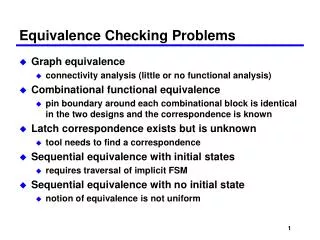
Previous approaches—Cutpoint • Cutpoint-based verification Three phases: • Choose cut-points • The overall verification task is partitioned along these cutpoints into a set of smaller verification problems which are solved independently • Eliminate false negatives PO PI
F G f2 g2 z z f1 g1 y y x x Previous approaches—False Negatives • False Negatives: Two functions are equivalent, but the verification algorithm declares them as different. • Methods to handle false negatives • Based on re-substitution • Based on cut frontiers • Based on ATPG (Automatic Test Pattern Generation) technique Let f1(x)=g1(x) x • if f2(z,y) g2(z,y), z,y then f2(f1(x),y) g2(f1(x),y) F G • if f2(z,y) g2(z,y), z,y f2(f1(x),y) g2(f1(x),y) F G
Presented Approach • The verification technique presented in this paper, utilizes BDDs, circuit graph hashing, cutpoint guessing and false negative elimination. • Differences from previous approaches: • The processing of BDDs is prioritized by their size and limited to an upper bound • The BDD construction is not stopped at cutpoints.
Verification Overview G F Boolean functions • Implemented as a Boolean reasoning engine. Construct circuit graph Identify equivalent parts using hash table Compute BDDs Identify equal functions Mark potential cutpoints Inject new BDDs using cutpoints Check false negatives Equal/Not Equal Undecided
Basic Algorithm for Equivalence Checking • Basic procedure • Construct circuit model using two-input AND gates and inverters. • Perform actual comparison
Circuit graph manipulation—example (a) Two functionally identical circuits (c) BDDs are computed for vertices 1, 2, 3, 4, 5 (b) Original graph for both circuits
Circuit graph manipulation—example (a) Two functionally identical circuits (e) Forward hashing causes 7 and 8 to merge and solves the verification problem (d) BDD is computed for 6 which causes 6 and 2 to merge
Advanced Algorithm Using Cut Frontiers • All vertices that have been merged are now used as cutpoints to inject new BDD variables onto the heap • All cutpoints with identical cut levels are assigned to a cut frontier
Elimination of False Negatives • Cutpoint variables need to be resubstituted by their driving functions • The elimination process is controlled by a heap • Initialize heap with all BDDs • Take the BDD with smallest size, re- substitute its topmost cut variable
Practical Experiments • Validate the assumptions that many industrial circuits are structurally similar • The technique was measured for a number of IBM internal circuits Number of functionally equivalent vertices versus total number of vertices in typical circuit graphs
Practical Experiments Verification performance for selected circuits
Conclusions • The paper presents a new method to perform functional comparison of combinational circuits using BDDs, circuit graph hashing , cutpoint guessing and false negative elimination. • The presented approach performs efficiently for a wide variety of designs with some degree of structural similarity.