Download
1 / 6
60 likes | 169 Views
This draft presents the 4rd (IPv4 Residual Deployments) Stateless Solution as an experimental approach for IPv4-IPv6 interoperability. Key changes and improvements since IETF 84 include the modification of the intended status, editorial adjustments, and the addition of a DHCPv6 container. The document outlines the protocol specifications for Customer Equipment (CE) and Border Routers (BR), detailing their respective code sizes and functionalities. The implementation highlights 4rd's lightweight packet translation without altering IP protocol standards, ensuring compatibility with existing RFCs and providing seamless deployment in current networks.

E N D
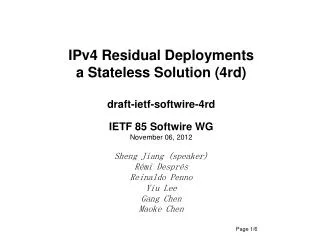
IPv4 Residual Deploymentsa Stateless Solution (4rd)draft-ietf-softwire-4rdIETF 85 Softwire WGNovember 06, 2012Sheng Jiang (speaker)Rémi Després Reinaldo Penno Yiu Lee Gang Chen Maoke Chen Page 1/6
Changes since IETF 84 • Change Intended Status to be Experimental • Editorship change • Thanks Rémi Després • Deletion of Rule IPv6 suffixes • Addition of the DHCPv6 container to avoid multiple option requests • A few minor description improvements from implementation • Move R1 into Section 4 “Protocol specification” – all Requirement in section 4 now • Add summary requirement lists that CE and BR should respectively obey for better readability
4rd logical functions (CE) Code size: 2300 lines, including NAT44 with port restriction Compiled ko file: 20 k
4rd logical functions (BR) • Code size: 2000 lines, code is reused from CE code • BR = CE – NAT44 – addr calculation from delegated IPv6 prefix • Compiled ko file: 18 k
Implementation Conclusion • 4rd doesn’t change any IP protocol standards, no conflict with any existing RFCs. In our implementation, the fragment header did not bother Linux forwarding at all. 4rd can be incremental deployed among current IP routers. • 4rd packet translation is lightweight • No need to deal with transport-layer checksum. CNP works effectively, the translated packets can pass the TCP/UDP checksum validation • No need to process each protocol (TCP/UDP/ICMP) respectively • No need to deal with ICMPv4/v6 semantic mapping. ICMPv4 can traverse the 4rd domain transparently
Comments are welcomed! Thank You!