Understanding Actual and Percent Yields in Chemical Reactions
30 likes | 149 Views
In chemical reactions, the actual yield often differs from the theoretical yield due to incomplete reactions. This article explores the concept of yields, using the reaction between LiOH and KCl as an example. Starting with 20g of LiOH, we can calculate the theoretical yield of LiCl produced and compare it to the actual yield obtained. Through step-by-step calculations, we derive the percent yield, which helps assess the viability of the reaction. Learn the importance of these yield calculations in practical chemistry!


Understanding Actual and Percent Yields in Chemical Reactions
E N D
Presentation Transcript
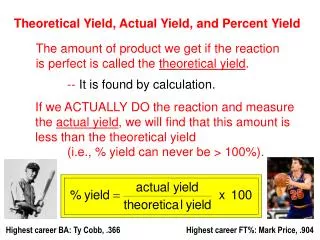
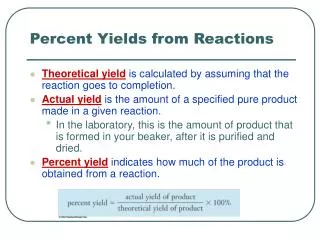
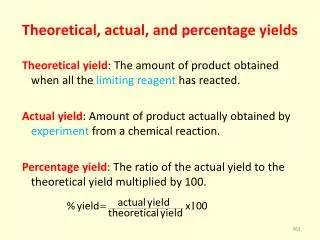
Actual and Percent Yields So far when we have been talking about reactions we have been talking about 100% of the (limiting) reactant becoming a product. However in real- life most of the time some of the reactants do not react so our theoretical (if 100% of reactants become product) yield is different from our actual yield. We can express this difference as a percentage to see if a reaction would be viable.
LiOH + KCl KOH + LiCl If I start this reaction with 20g of LiOH, what mass of LiCl should I get? If I actually get 6g of LiCl, what is my percent yield? Step 1: Write a balanced equation Step 2: Calculate the number of moles of reactant 1 mole LiOH = 24g 20g = 20/24 moles = 0.83 moles
Step 3: Use mole ratios to calculate the mass of product 1 mole LiOH : 1 mole LiCl 0.83 moles LiOH : 0.83 moles LiCl 1 mole LiCl = 42.5g 0.83 moles = 42.5 x 0.83 = 35.28g Theoretical Yield From question Step 4: Calculate percent yield using the formula Actual yield % yield = 6 X 100 X 100 Theoretical yield 35.28 From step 3 = 17% yield