Download

1 / 23
230 likes | 356 Views
A robust financial plan is crucial for demonstrating your business's financial viability to lenders and stakeholders. It typically encompasses three main aspects: solvency, profitability, and liquidity. To effectively present your financial situation, include essential documents such as a balance sheet, income statement, and cash flow plan. Additionally, outline your assumptions and strategies for capital asset management, along with a summary of the funding required to execute your business plan. Utilize tools like FINPACK for precise financial projections and insights.

E N D
Financial Plan • Your lender wants to know if your business will be financially successful. • Your spouse wants to know too!
Financial Plan • In many cases, the financial plan is the most important part of your business plan. • The financial plan is particularly important if you are proposing a major change or a new business.
Financial Plan • What do you need to include in your business plan to communicate financial viability?
Financial Plan • Financial viability is generally evaluated from three perspectives: • Solvency • Profitability • Liquidity
Financial Plan • Solvency evaluates changes in net worth • growth in your retirement account • Profitability monitor earnings • ability to generate income • Liquidity estimates cash flow and debt repayment ability • paying the bills when due
Solvency • Compares the assets invested (what you own) in the business with the sources of capital (liabilities – what you owe and your net worth) • Requires an up to date balance sheet
Profitability • Measures the earnings of the business • Requires an accrual income statement • Optionally use average net income from 3 years Schedule F tax forms
Liquidity • Measures the ability of the business to generate cash to meet short term obligations • Requires a cash flow statement, usually projected for next year or more
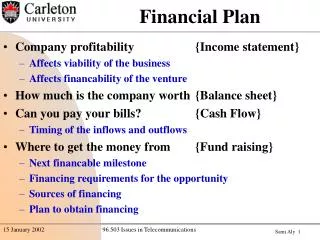
Financial Plan • The tools used to communicate a business’s financial situation are: • Balance sheet - solvency • Income statement - profitability • Cash flow plan – liquidity
Balance Sheet • A snapshot of how funds are invested in a business (assets) and the financing methods used (liabilities and owner’s equity) at a given point in time.
Balance Sheet • Most producers have an existing balance sheet because lenders require one annually. • If you need to develop or update your balance sheet you can use FINPACK or use the Guide worksheet.
Income Statement • An income statement measures how much income the business is making in relation to the resources used to produce that income.
Income Statement • Not all producers have an accrual income statement. • Should develop one for your business plan. • Can use FINPACK or the Guide worksheet.
Cash Flow Plan • A cash flow plan is a projection of all sources and uses of cash during a specified planning period. • It evaluates the business’s ability to meet loan payments and other financial obligations on time.
Cash Flow Plan • Most producers have an annual cash flow plan. • If you need to develop or update your cash flow plan you can use FINPACK or use the Guide worksheet.
Financial Plan • Include a balance sheet, income statement, and cash flow plan in your business plan.
Financial Plan • A written description of the strengths of these three measurements of your financial projections should also be included. • Also describe the assumptions you used to make your financial projections.
Your Financial Numbers • Generating your financial statements from a program like FINPACK will make development of your business plan easier. • FINPACK provides not only a balance sheet, income statement, and cash flow, but also financial ratios to help evaluate the meaning of your financial numbers.
Asset Management • Your financial plan should also describe how you acquire and manage capital assets - purchase, lease, or custom hire. • How efficiently are assets being used?
Asset Management • An analysis of your investment in capital assets relative to the size of your business may be valuable as you plan the future of your business. • Asset management is often the best indicator of future net worth growth.
Capital Required • The final part of your financial plan should describe how much money you need to implement your business plan. • Describe the sources of your financing. • Present your financing request if you have one.
Resources • Guide worksheets • Balance sheet – worksheet 4.35 • Projected profitability - worksheet 4.33 • Cash flow – worksheet 4.34
Resources • FINPACK Business Plan software • Balance sheet • Asset management • Projected profitability • Cash flow • Long range projections • Historical trends • Benchmarks • Capital required