Download
1 / 11
110 likes | 224 Views
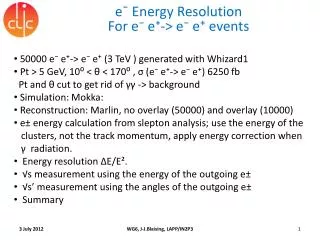
This document addresses energy resolution issues discussed in the last meeting regarding electron-positron collisions. It explores various event selection criteria to mitigate bremsstrahlung effects and improve accuracy. By leveraging cluster energy instead of track momentum, the analysis reveals that Bhabha event energy resolution can reach ΔE/E = 1.5% for 1.5 TeV e±. Further, the discussion includes the impact of photons and neutrons on energy resolution, demonstrating correction strategies for improved alignment with expected values, emphasizing the need for refined data handling in simulation software.

E N D
e⁻ e⁺-> e⁻ e⁺ Energy ResolutionIssues After Last meeting • Select events with 2 tracks only, to remove bremsstrahlungevents • Use energy of the clusters, not the track momentum • Energy resolution for bhabha events is : • ΔE/E ² = 2.3 10¯⁵ => ΔE/E = 3.5 % for 1.5 TeV e± • Why is ΔE # 0.2/√E + 0.01 (CDR) = 1.12 % at 1.5 TeV ? WG6, J-J.Blaising, LAPP/IN2P3
Energy ResolutionEvents without Photons • To understand the e- energy resolution: Select events without FSR and Bremssthalung (using the generator and simulation status bits), 9500 events left. • These events should not contain photons, but ~ 2/3 have γs. • The γs are created by Pandora which breaks e± into e± and nγ (known feature). • Is not an issue; the analysis software recombines them. • In the events left, 90% contain PFOs which are neutrons. • When these events are removed only ~ 300 events are left and ΔE/E²=5.110¯⁶ • But mean value off by 3%. WG6, J-J.Blaising, LAPP/IN2P3
Energy ResolutionEvents without Photons • Apply event/event correction x0.97 • => ΔE/E²=9.7 10¯⁶ • ΔE/E= 1.5 % for 1.5 Tev e± • Close to the expected value ΔE/E=1.12 % WG6, J-J.Blaising, LAPP/IN2P3
Energy ResolutionEvents with Photons and Neutrons • Force software to consider neutrons as photons • => ΔE/E² =1.25 10¯⁵. • but the mean value is off by 3%. • Apply global E correction • ΔE/E² =1.18 10¯⁵ • ΔE/E = 1.8% for 1.5 TeV e± • This is ~ a factor two better wr. to last meeting and closer tothe expected resolution 1.12 % (CDR) • The right treatment of the neutral energy deposit in the HCAL, may improve the resolution further. WG6, J-J.Blaising, LAPP/IN2P3
ΔE/E ΔE/E as a function of E: For 500 GeV < E > 1500 GeV: ΔE/E=0.38/√E+ 0.01 Expected ΔE/E=0.2/√E+0.01 WG6, J-J.Blaising, LAPP/IN2P3
Photons ΔE/E Use Mokka gun to simulate γs at θ=30⁰, smeared over φ, Eγ=200, 400, 600,800, 1000 GeV After reconstruction, remove events with photon conversion, for each file of 2000 events ~ 1300 events are left. Remove events with Neutrons, 90% left at 200 GeV, 50% at 400 GeV ΔE/E=1.9% at 200 GeV and 1.6% at 400 GeV, but mean shifted WG6, J-J.Blaising, LAPP/IN2P3
Photons ΔE/E 15% left at 600 GeV, 12% at 800 GeV ΔE/E=1.4% at 600 GeV and 1.4% at 800 GeV, mean shift increases with energy of γ WG6, J-J.Blaising, LAPP/IN2P3
Photons ΔE/E For γ events without neutrons the energy resolution ~ ok , but he mean value of ΔE/E is off; the offset increases with Eγ The number of events with neutrons increases with Eγ; why ? For e± events the mean of ΔE/E² is off ~ 3% WG6, J-J.Blaising, LAPP/IN2P3
Backup WG6, J-J.Blaising, LAPP/IN2P3
√s’ WG6, J-J.Blaising, LAPP/IN2P3
√s’ WG6, J-J.Blaising, LAPP/IN2P3