Cells
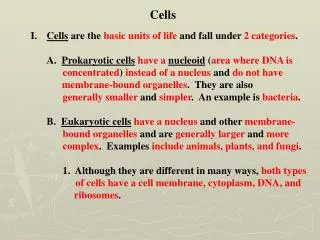
Cells. Chapter 3. Cells. The Cell Theory Emerges. Modern cell theory All organisms consists of one or more cells Each new cell arises from division of another, preexisting cell A cell is the smallest unit with the properties of life

Cells
E N D
Presentation Transcript
Cells Chapter 3
The Cell Theory Emerges • Modern cell theory • All organisms consists of one or more cells • Each new cell arises from division of another, preexisting cell • A cell is the smallest unit with the properties of life • Each cell passes its hereditary material to its offspring
All Cells Have: • Plasma membrane • Controls substances passing in and out of the cell • DNA • Cytoplasm • A semifluid mixture containing cell components • Ribosomes
2 Categories of Cells • Prokaryotic cell • Small, simple cells without a nucleus • Eukaryotic cell • Cell interior is divided into functional compartments, including a nucleus
Prokaryotic Cell Note what it is lacking
Concentration Gradients • Concentration • The number of molecules of substance per unit volume of fluid • Concentration gradient • The difference in concentration between two adjacent regions • Molecules move from a region of higher concentration to one of lower concentration
Diffusion • Diffusion • The net movement of molecules down a concentration gradient • Moves substances into, through, and out of cells
Extracellular Fluid glucose Cytoplasm lipid bilayer A A glucose molecule (here, in extracellular fluid) binds to a transport protein embedded in the lipid bilayer. Fig. 5-9a, p. 84
B Binding causes the protein to change shape. Fig. 5-9b, p. 84
C The glucose molecule detaches from the transport protein on the other side of the membrane (here, in the cytoplasm), and the protein resumes its original shape. Fig. 5-9c, p. 84
Osmosis • Osmosis • The movement of water down its concentration gradient – through a selectively permeable membrane from a region of lower solute concentration to a region of higher solute concentration
Tonicity • Hypotonic- lower solute concentration • Hypertonic- higher solute concentration • Water diffuses from hypotonic to hypertonic • Isotonic fluids have the same solute concentration
Tonicity Experiment 2 % sucrose 10% sucrose water Fig. 5-17a, p. 89
D Red blood cells in a hypotonic solution swell because water diffuses into them. B Red blood cells in an isotonic solution do not change in volume. C Red blood cells in a hypertonic solution shrivel because water diffuses out of them. Fig. 5-17 (b-d), p. 89
Are paramecium’s surroundings hypotonic, hypertonic, or isotonic?
Woman Dies of Water Intoxication-2007 “Hold Your Wee for a Wii Contest”